
Contract Templates
125 free, ready-to-use contract templates, grouped by deal stage. Each links to a fillable form you can review and download.
Employment
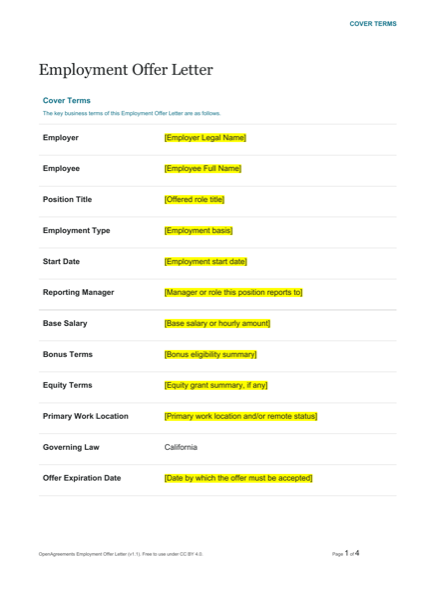 OpenAgreementsEmployment Offer LetterA startup-focused employment offer letter template for full-time or part-time hiring with compensation, equity summary, and at-will framing. Select the governing law explicitly; use a state-specific offer when available and provide any separate required wage notice.
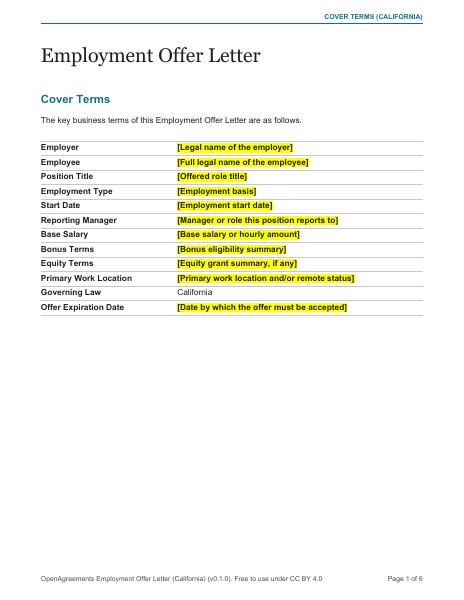 OpenAgreementsEmployment Offer Letter (California)State-specific employee offer letter template for employees primarily working in California.
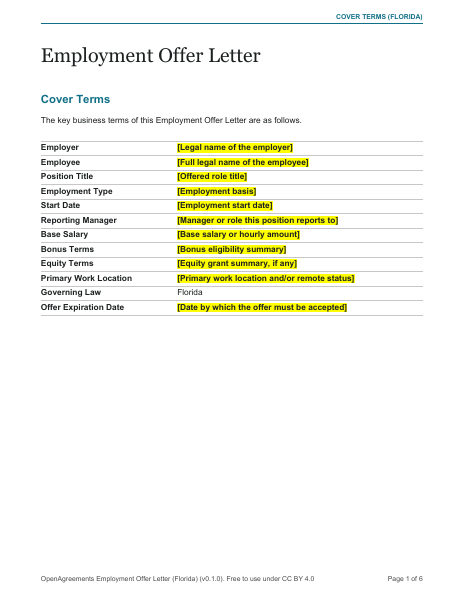 OpenAgreementsEmployment Offer Letter (Florida)State-specific employee offer letter template for employees primarily working in Florida.
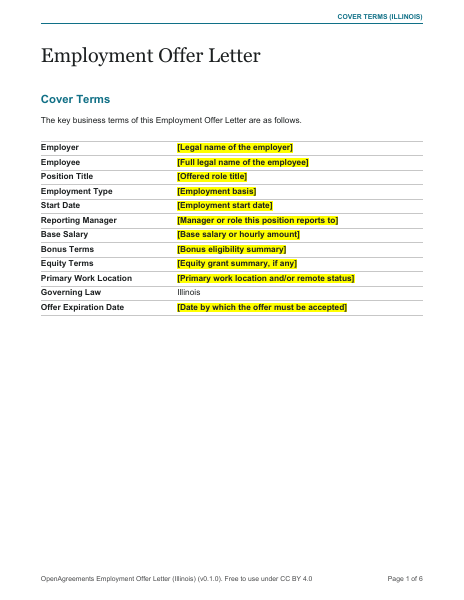 OpenAgreementsEmployment Offer Letter (Illinois)State-specific employee offer letter template for employees primarily working in Illinois.
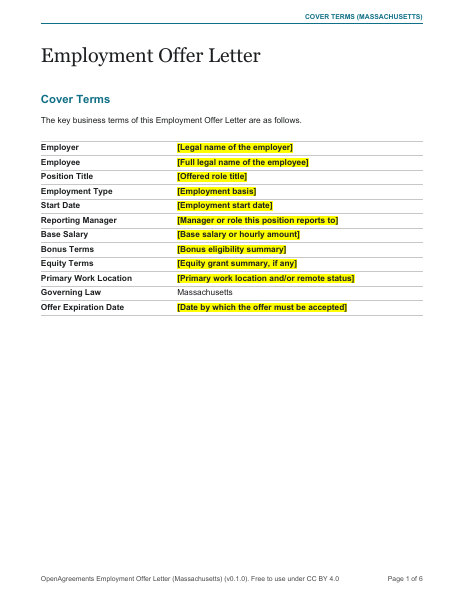 OpenAgreementsEmployment Offer Letter (Massachusetts)State-specific employee offer letter template for employees primarily working in Massachusetts.
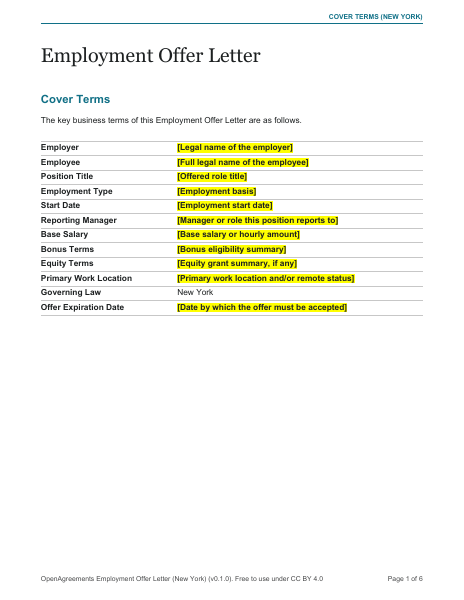 OpenAgreementsEmployment Offer Letter (New York)State-specific employee offer letter template for employees primarily working in New York.
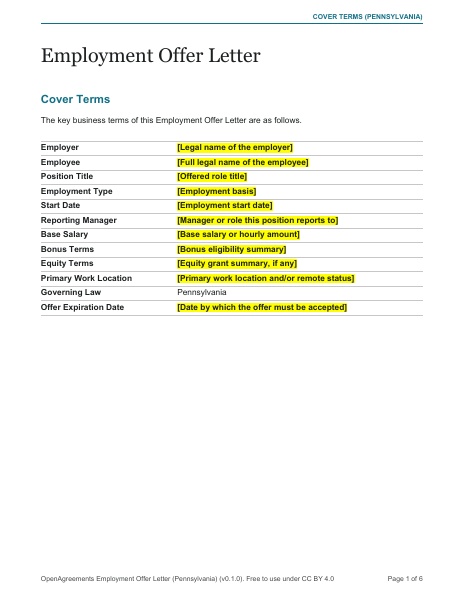 OpenAgreementsEmployment Offer Letter (Pennsylvania)State-specific employee offer letter template for employees primarily working in Pennsylvania.
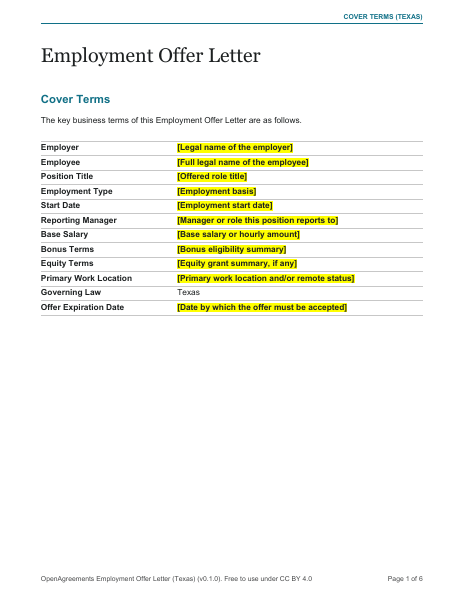 OpenAgreementsEmployment Offer Letter (Texas)State-specific employee offer letter template for employees primarily working in Texas.
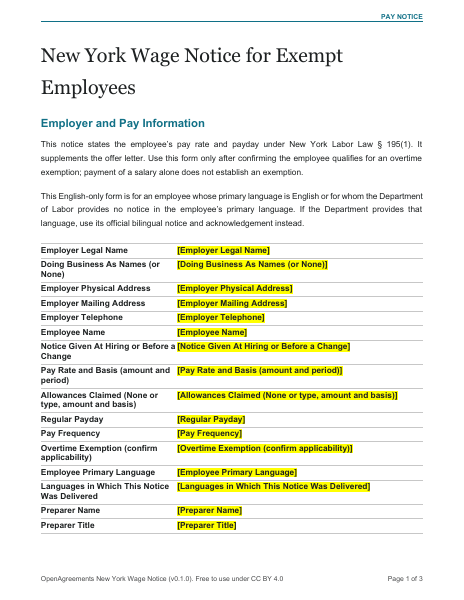 OpenAgreementsWage Notice (New York Exempt Employees)New York wage notice companion for employees who qualify as overtime-exempt. Based on NYDOL LS59. English-only: use for English-primary employees or a primary language for which NYDOL has no form. Use the official bilingual notice when NYDOL provides the employee’s language. Salary alone does not establish exemption.
Non-Competes / Restrictive Covenants
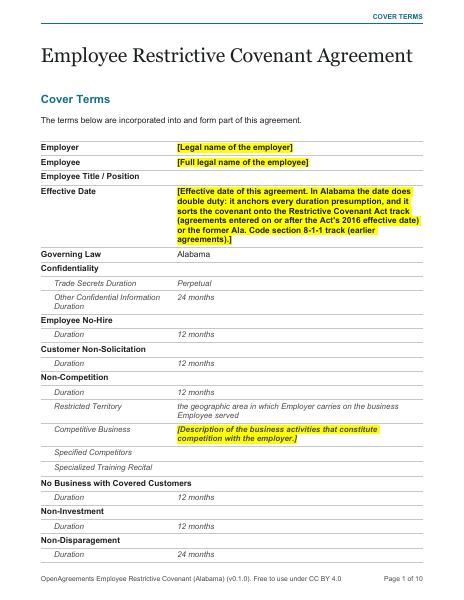 OpenAgreementsEmployee Restrictive Covenant (Alabama)Alabama-specific employee restrictive covenant agreement built for the Alabama Restrictive Covenant Act, Ala. Code section 8-1-190 et seq.: confidentiality and trade-secret protection, a current-customer non-solicitation, an employee no-hire covenant confined to uniquely essential workers, and an optional non-compete drawn to the section 8-1-190(b)(4) employee exception. Recites the void-by-default rule and its six safe-harbor categories, ties each covenant to a section 8-1-191 protectable interest, keeps durations within the statutory presumptions (two years employee non-compete, eighteen months current-customer non-solicit), confirms the section 8-1-192 all-parties signature and adequate-consideration formalities, avoids execution before the employment relationship exists, carves out the section 8-1-196 professional exemption, treats reformation as reaching only duration, and applies Alabama's fundamental-policy conflicts rule. Drafted as a starting point for licensed counsel review.
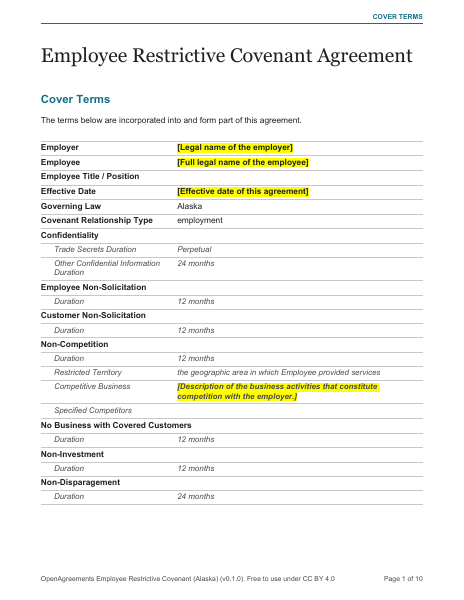 OpenAgreementsEmployee Restrictive Covenant (Alaska)Alaska-specific employee restrictive covenant agreement built for Alaska's pure common-law reasonableness regime: there is no general Alaska non-compete statute, so every post-employment restraint stands or falls on Alaska Supreme Court case law — non-competition agreements are strictly construed and weighed against the common-law reasonableness factors (reasonably necessary to protect a legitimate business interest and no broader than needed). It provides confidentiality and trade-secret protection alongside the Alaska Uniform Trade Secrets Act (AS 45.50.910–.945), customer and employee non-solicitation, an optional customer non-dealing covenant scoped to the customers and information the employer procured at its own expense, an optional non-compete drawn to the reasonable-necessity gate, optional non-investment, sale-of-business public-injury weighing for covenants tied to a business sale, and a reasonable-alteration posture that the drafting does not rely on — judicial rescue of an overbroad covenant is available only to an employer that carries the burden of proving good-faith drafting, with willful overreach forfeiting alteration. Drafted as a starting point for licensed counsel review.
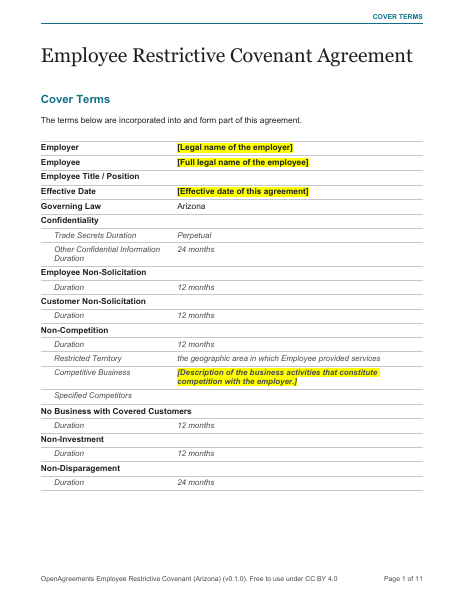 OpenAgreementsEmployee Restrictive Covenant (Arizona)Arizona-specific employee restrictive covenant agreement built for Arizona's common-law reasonableness regime: there is no general Arizona non-compete statute, so every post-employment restraint stands or falls on Arizona's reasonableness test — a restriction is unreasonable and will not be enforced if it is greater than necessary to protect the employer's legitimate interest, or if that interest is outweighed by hardship to the employee and likely injury to the public. It provides confidentiality and trade-secret protection backstopped by the Arizona Uniform Trade Secrets Act (A.R.S. §§ 44-401 to 44-407), a continued-at-will-employment consideration recital, customer and employee non-solicitation drawn to the protectable-interest threshold, an optional non-compete sized to the actual footprint, confidentiality and non-solicits scoped so they do not operate as de-facto non-competes, a broadcast-employer screening recital for the one statutory ban (A.R.S. § 23-494), physician covenants drafted for Arizona's heightened public-interest scrutiny, and grammatically severable covenant drafting for Arizona's strict trim-only blue pencil, which strikes overbroad terms but never rewrites them. Drafted as a starting point for licensed counsel review.
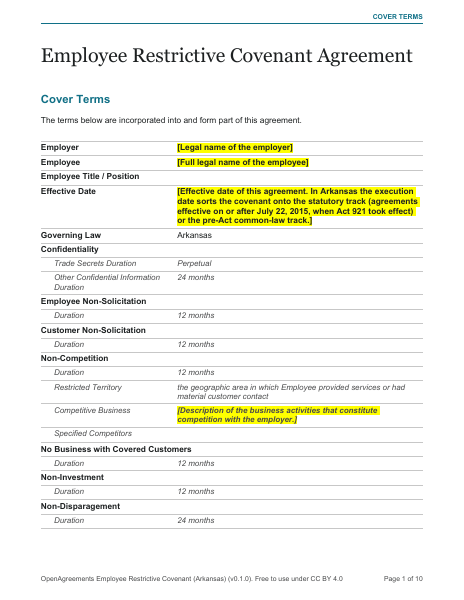 OpenAgreementsEmployee Restrictive Covenant (Arkansas)Arkansas-specific employee restrictive covenant agreement built for Ark. Code Ann. section 4-75-101: confidentiality and trade-secret protection, employee and customer non-solicitation, a non-dealing covenant, and an optional non-compete drawn to the statutory protectable-interest and time-and-scope test. Recites the statutory categories of protectable business interest, keeps durations within the two-year presumptively-reasonable window, relies on the continued-employment consideration rule, voids any practice restriction on a physician under the 2025 amendment, flags the Title 17, Subtitle 3 licensed-professional exclusion, and acknowledges the mandatory judicial reformation remedy. Drafted as a starting point for licensed counsel review.
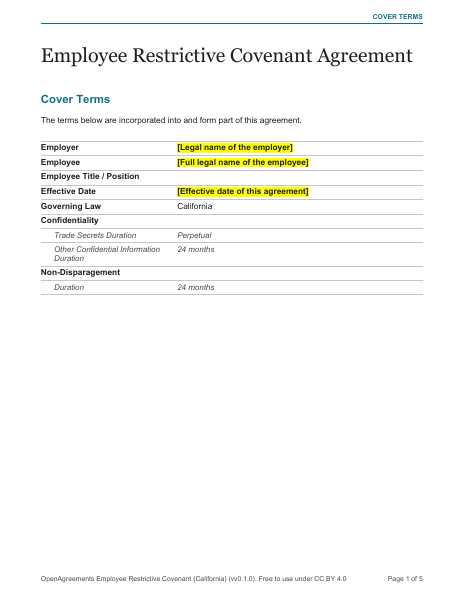 OpenAgreementsEmployee Restrictive Covenant (California)California-specific employee restrictive covenant agreement centered on confidentiality, trade secret protection, property return, and non-disparagement. Omits employee competition, customer-solicitation, employee-solicitation, non-dealing, and non-investment employment restraints under Cal. Bus. & Prof. Code sections 16600, 16600.1, and 16600.5, and includes California choice-of-law and forum language reflecting Cal. Lab. Code section 925. Drafted as a starting point for licensed counsel review.
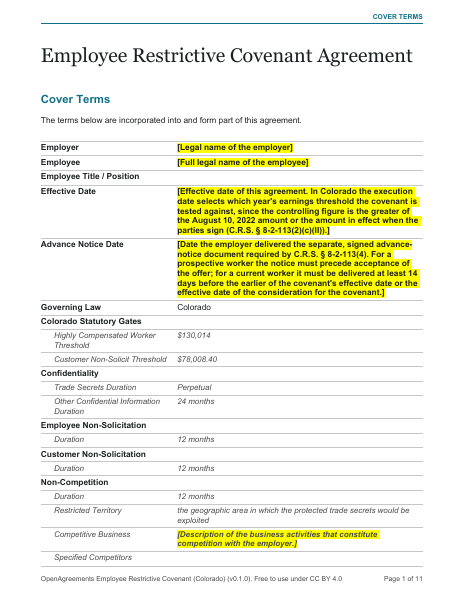 OpenAgreementsEmployee Restrictive Covenant (Colorado)Colorado-specific employee restrictive covenant agreement built for C.R.S. § 8-2-113: confidentiality and trade-secret protection with the statutory general-skills and protected-disclosure carve-outs, an employee non-solicitation covenant, a customer non-solicitation covenant gated on sixty percent of the highly compensated worker threshold ($78,008.40 for 2026), and an optional non-compete gated on the highly compensated worker threshold ($130,014 for 2026) and tied to trade-secret protection. Both earnings gates run at signing and at enforcement. The agreement flags the separate, signed 14-day advance-notice document the statute requires, excludes restrictive covenants for health-care providers under S.B. 25-083 with the patient-communication protections, keeps Colorado law and a Colorado forum for Colorado-based workers, and drafts each covenant within its enforceable scope rather than relying on discretionary judicial reformation. Drafted as a starting point for licensed counsel review.
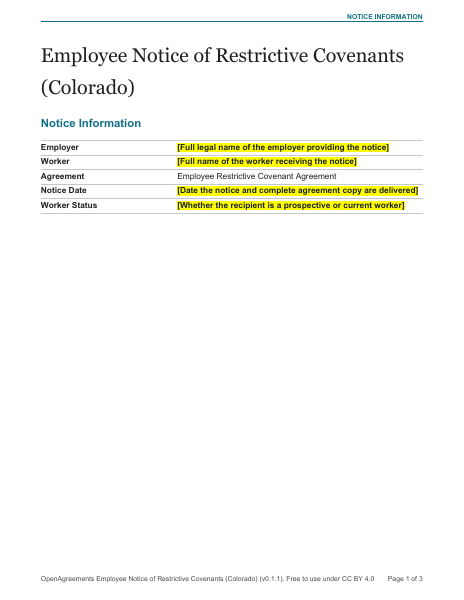 OpenAgreementsEmployee Notice of Restrictive Covenants (Colorado)Separate worker notice accompanying the Colorado Employee Restrictive Covenant Agreement under C.R.S. § 8-2-113(4).
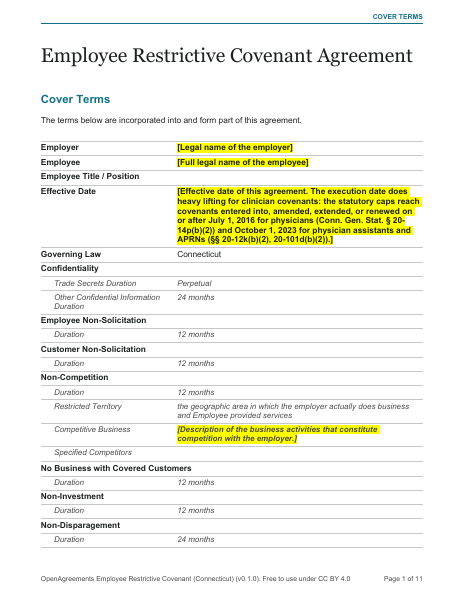 OpenAgreementsEmployee Restrictive Covenant (Connecticut)Connecticut-specific employee restrictive covenant agreement built for Connecticut's common-law reasonableness regime: there is no general Connecticut non-compete statute, so every post-employment restraint stands or falls on the five-factor common-law reasonableness test (partial and restricted as to time or place, fair protection of the employer, no undue hardship on the employee, no interference with the public interest, and no preclusion of the employee's occupation and livelihood). It provides confidentiality and trade-secret protection backstopped by the Connecticut Uniform Trade Secrets Act (Conn. Gen. Stat. §§ 35-51 to 35-53), a continued-employment consideration recital drafted to prove the connection Connecticut's current consideration case law requires, customer and employee non-solicitation, an optional non-compete tied to a recognized protectable interest and sized to the employer's actual footprint, a physician clause reciting the § 20-14p one-year and fifteen-mile caps and the parallel §§ 20-12k / 20-101d caps for physician assistants and APRNs, statutory carve-outs excluding security-guard (§ 31-50a), broadcast-employee (§ 31-50b), and homemaker-companion / home-health (§§ 20-681, 20-683) restraints, and separable, tiered restraints drafted within their enforceable scope rather than in reliance on discretionary judicial narrowing, which Connecticut authority leaves unsettled. Drafted as a starting point for licensed counsel review.
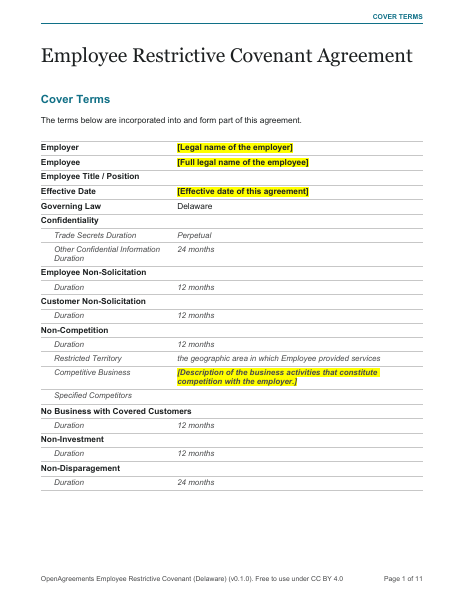 OpenAgreementsEmployee Restrictive Covenant (Delaware)Delaware-specific employee restrictive covenant agreement built for Delaware's common-law reasonableness regime: there is no general Delaware non-compete statute, so every post-employment restraint stands or falls on the Court of Chancery's three-part review (reasonable in geographic scope and temporal duration, advancing a legitimate economic interest, and surviving a balancing of the equities), evaluated holistically across every dimension of the covenant. It provides confidentiality and trade-secret protection backstopped by the Delaware Uniform Trade Secrets Act (6 Del. C. §§ 2001-2007), a formation-stage consideration recital that names the value exchanged, customer and employee non-solicitation, an optional non-compete sized to identified legitimate interests, physician practice-covenant compliance that voids any practice restraint while preserving reasonably related damages (6 Del. C. § 2707), a home-inspector-trainee carve-out (24 Del. C. § 4109(d)), a Delaware choice-of-law anchor bounded by its statutory and conflict-of-law limits (6 Del. C. § 2708), and a draft-the-scope reformation posture the agreement does not rely on because recent decisions increasingly refuse to blue-pencil an overbroad covenant. Drafted as a starting point for licensed counsel review.
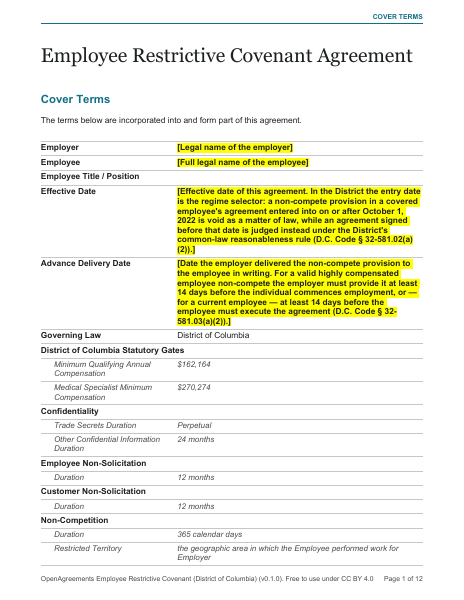 OpenAgreementsEmployee Restrictive Covenant (District of Columbia)District of Columbia employee restrictive covenant agreement built for the Ban on Non-Compete Agreements Amendment Act of 2020 (D.C. Code §§ 32-581.01–.04b): confidentiality and trade-secret protection with the statutory information carve-out, an employee non-solicitation covenant, a customer non-solicitation covenant, and an optional non-compete confined to a highly compensated employee — one at or above the annually indexed minimum qualifying annual compensation ($162,164 for most employees in 2026; $270,274 for a medical specialist). The non-compete recites every § 32-581.03(a) validity gate: a stated functional scope and geographic limits, a term of no more than 365 calendar days from separation (730 for a medical specialist), and delivery of the covenant in writing at least 14 days in advance, with the prescribed statutory notice and the workplace-policy disclosure flagged as companion writings. For a covered employee below the threshold the covenant is banned and void as a matter of law, so the template omits it by default and never relies on judicial reformation to cure overbreadth. Drafted as a starting point for licensed counsel review.
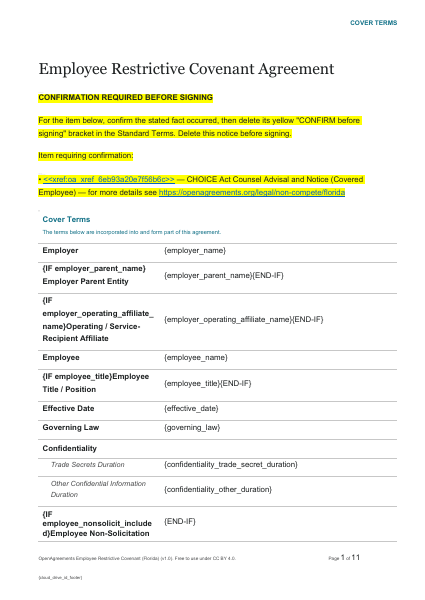 OpenAgreementsEmployee Restrictive Covenant (Florida)Florida-specific employee restrictive covenant agreement with modular covenant structure (non-compete, non-solicitation, non-dealing, non-investment, confidentiality, non-disparagement). Implements Fla. Stat. section 542.335 (legitimate-business-interest recital, mandatory judicial modification of overbroad restraints, express assignee / successor / third-party-beneficiary enforcement), the section 542.336 physician specialty-monopoly carve-out, and the 2025 CHOICE Act (sections 542.41-542.45) covered-employee enhanced- enforcement track. Drafted as a starting point for licensed counsel review.
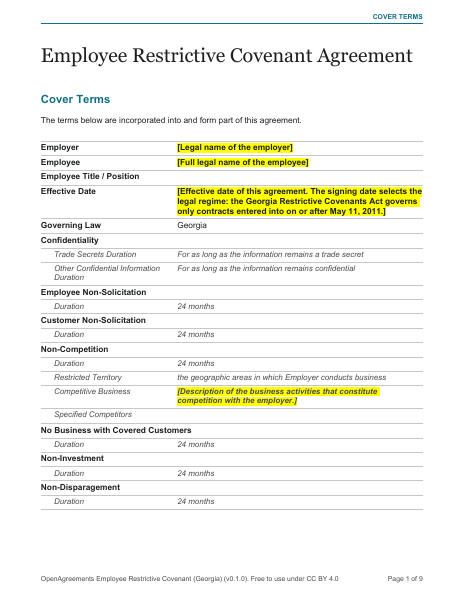 OpenAgreementsEmployee Restrictive Covenant (Georgia)Georgia-specific employee restrictive covenant agreement built for the Georgia Restrictive Covenants Act (O.C.G.A. § 13-8-50 et seq.): confidentiality and trade-secret protection keyed to continued protection under § 13-8-53(e), a customer non-solicitation anchored to material-contact customers under § 13-8-53(b) with no express geographic term required, an optional non-compete gated on the § 13-8-53(a) covered-employee functions and drafted to reasonable time, geographic area, and scope within the § 13-8-57(b) two-year presumption window, discretionary narrowing-only judicial modification under § 13-8-53(d), and Georgia choice-of-law language reflecting that Georgia law is the touchstone for enforceability. Drafted as a starting point for licensed counsel review.
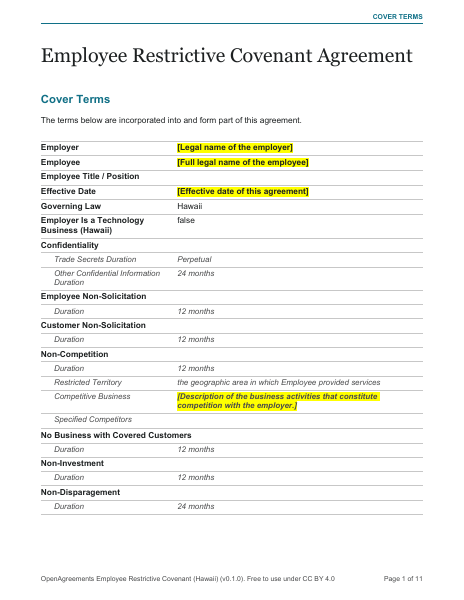 OpenAgreementsEmployee Restrictive Covenant (Hawaii)Hawaii-specific employee restrictive covenant agreement built for HRS chapter 480's restraint-of-trade framework: confidentiality and trade-secret protection, customer and employee non-solicitation, and an optional non-compete, each drawn to the legitimate-ancillary-purpose screen of HRS section 480-4(c) and the statutory reasonableness factors. Non-competes and employee non-solicits are struck automatically when the employer is a technology business (HRS section 480-4(d)), leaving the trade-secret covenant as the surviving restraint. The Solicit definition tracks the active-initiation standard, and each restraint is drawn to its minimum supporting interest rather than in reliance on judicial narrowing. Drafted as a starting point for licensed counsel review.
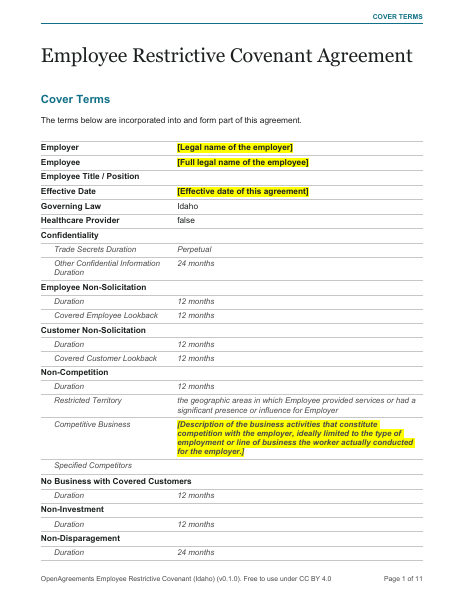 OpenAgreementsEmployee Restrictive Covenant (Idaho)Idaho-specific employee restrictive covenant agreement built for Idaho Code title 44, chapter 27: confidentiality and trade-secret protection, customer and employee non-solicitation with a solicitation definition drawn to Idaho's affirmative-conduct rule for solicitation, and an optional non-compete gated on the statutory key-employee / key-independent-contractor class, capped at eighteen months absent added consideration, and fitted to the worker's actual geographic and line-of-business footprint. Includes a key-worker recital, a healthcare patient-access clause, mandatory statutory reformation under section 44-2703, and an Idaho-tribunal forum protection under section 29-110. Drafted as a starting point for licensed counsel review.
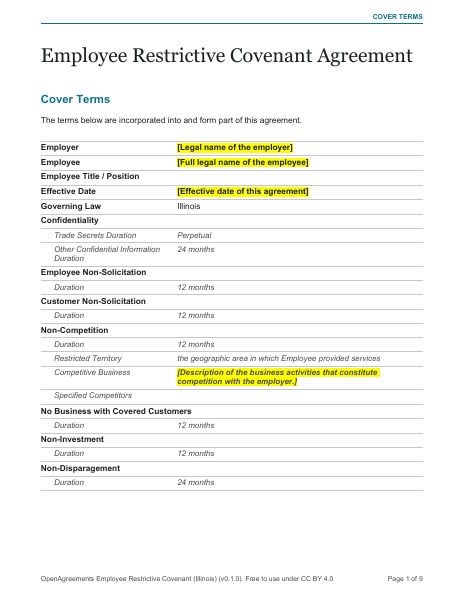 OpenAgreementsEmployee Restrictive Covenant (Illinois)Illinois-specific employee restrictive covenant agreement built for the Illinois Freedom to Work Act (820 ILCS 90): confidentiality and trade-secret protection, customer and employee non-solicitation gated on the $45,000 earnings floor, an optional non-compete gated on the $75,000 earnings floor, the written counsel advisal and 14-day review notice, an adequate-consideration recital, protected-worker exclusions, and discretionary judicial reformation. Drafted as a starting point for licensed counsel review.
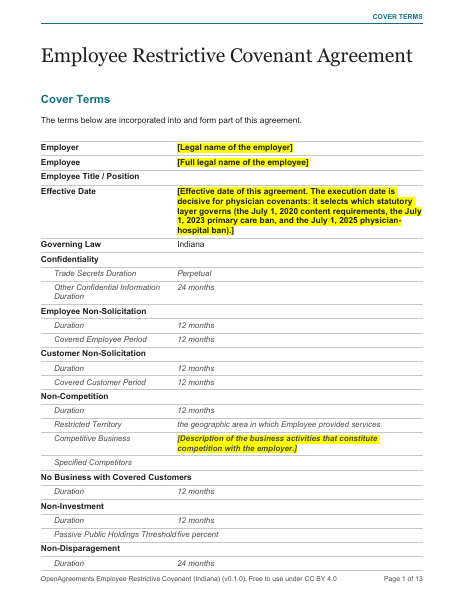 OpenAgreementsEmployee Restrictive Covenant (Indiana)Indiana-specific employee restrictive covenant agreement built for Indiana's common-law reasonableness regime: there is no general Indiana non-compete statute, so every post-employment restraint is a disfavored restraint construed strictly against the employer, which must first prove a legitimate protectable interest and then carry the burden of showing the restraint reasonable in time, activity, and geographic area. It provides confidentiality and trade-secret protection anchored to the Indiana Uniform Trade Secrets Act (Ind. Code § 24-2-3-2), customer and employee non-solicitation each tied to a protectable interest, and an optional non-compete sized to the employer's actual footprint. Because Indiana's blue pencil is a strict eraser that deletes but never rewrites, and a court cannot add terms even where the agreement purports to authorize it, the covenants are drafted as grammatically severable, independently reasonable units rather than in reliance on judicial reformation. The employee non-solicitation covenant is scoped to a protectable-interest-limited Covered Employees class rather than the workforce at large. A liquidated-damages provision is omitted by default because a sum grossly disproportionate to the loss is an unenforceable penalty. Physician covenants are governed by a layered statute stack keyed to execution date (House Enrolled Act 1004 (2020) content requirements including the reasonable-price buyout; the Senate Enrolled Act 7 (2023) primary care ban; the Senate Enrolled Act 475 (2025) physician-hospital ban). Drafted as a starting point for licensed counsel review.
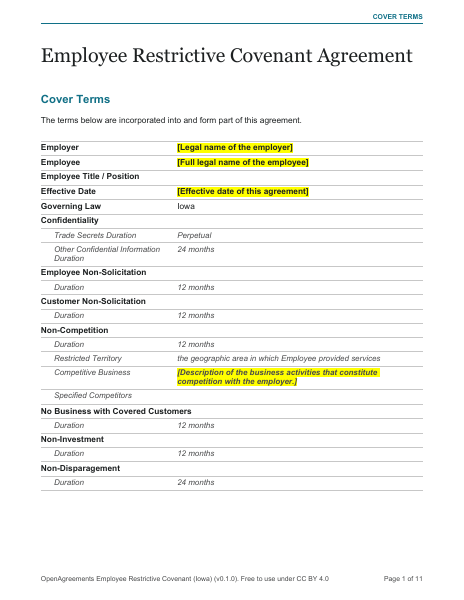 OpenAgreementsEmployee Restrictive Covenant (Iowa)Iowa-specific employee restrictive covenant agreement built for Iowa's common-law reasonableness regime: there is no general Iowa non-compete statute, so every post-employment restraint stands or falls on a three-prong reasonableness test (reasonably necessary to protect the employer, not unreasonably restrictive of the employee, not prejudicial to the public interest), under which the employer seeking enforcement carries the burden of proving reasonableness. It provides confidentiality and trade-secret protection backstopped by the Iowa Uniform Trade Secrets Act (Iowa Code ch. 550), a continued-employment consideration recital, customer and employee non-solicitation, an optional non-compete tied to identified protectable interests and sized to the actual footprint, and partial-enforcement reformation that the drafting does not rely on. It also discloses Iowa's narrow occupation and sector rules — the licensed-mental-health-professional practice-restraint ban (Iowa Code § 147.161), the health-care staffing-agency noncompete-and-conversion-fee ban (Iowa Code § 135Q.2), the franchise market-withdrawal nonrenewal disclaimer (Iowa Code § 537A.10), and the University of Iowa Hospitals and Clinics clinical-role prohibition (Iowa Code § 262.9(43)). Drafted as a starting point for licensed counsel review.
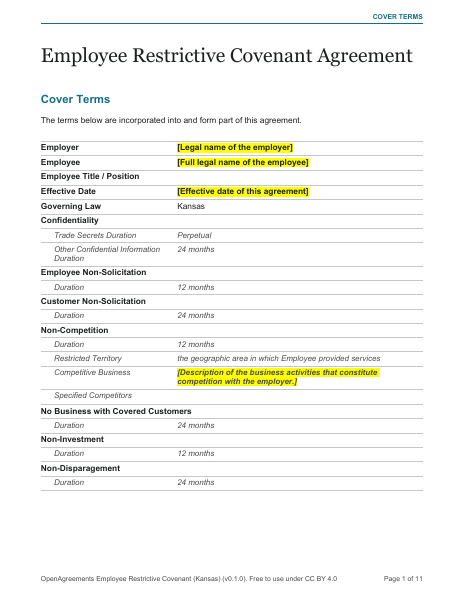 OpenAgreementsEmployee Restrictive Covenant (Kansas)Kansas-specific employee restrictive covenant agreement built for Kansas's common-law reasonableness regime: an employee non-compete is enforceable only as an adjunct to a lawful employment contract, when reasonable under the four-factor common-law test (legitimate business interest, no undue burden on the employee, no injury to the public welfare, and reasonable time and territory), with the employer carrying the burden and Kansas appellate courts reviewing enforceability without deference. It provides confidentiality and trade-secret protection alongside the Kansas Uniform Trade Secrets Act (K.S.A. 60-3320, 60-3326), a continued-at-will-employment consideration recital, a customer non-solicitation covenant drawn to the K.S.A. 50-163(c)(5) two-year material-contact-customer safe harbor, an employee non-solicitation covenant on ordinary reasonableness, an optional non-compete tied to identified protectable interests and sized to the actual footprint, a fixed-term no-open-ended-tolling clause, equitable narrowing that the drafting does not rely on (a court reduces an overbroad restraint but does not rewrite an already-reasonable term, and the K.S.A. 50-163(b) reformation command does not reach non-competes, which the Act excludes at § 50-163(e)(6)), and a physician covenant on the ordinary reasonableness test (no Kansas healthcare non-compete ban). Drafted as a starting point for licensed counsel review.
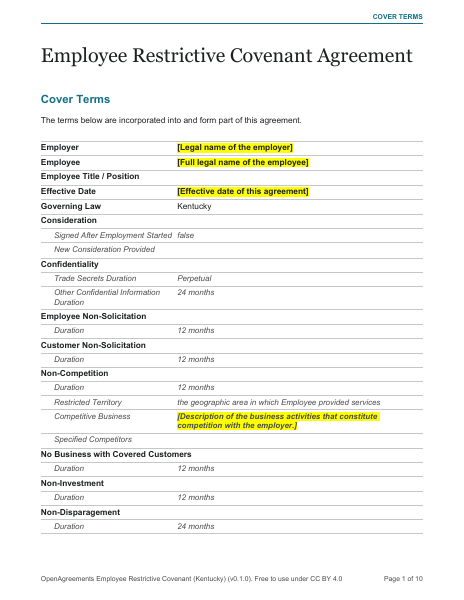 OpenAgreementsEmployee Restrictive Covenant (Kentucky)Kentucky-specific employee restrictive covenant agreement built for Kentucky's common-law reasonableness regime: there is no general Kentucky non-compete statute, so every post-employment restraint stands or falls on the fair-protection standard — fair protection to the employer's interests, no undue hardship on the party restricted, and no interference with the public interests. It provides confidentiality and trade-secret protection tied to the Kentucky Uniform Trade Secrets Act (KRS 365.880-365.900), a new-consideration recital for mid-employment covenants — continued at-will employment alone is not enough and a bare recital does not cure the gap — customer and employee non-solicitation, an optional non-compete tied to identified protectable interests and sized to the actual footprint, discretionary judicial reformation the drafting does not rely on, a Kentucky choice-of-law clause anchored in a genuine connection, a breach-tied extension flagged as an open Kentucky question, and the one categorical statutory ban — KRS 216.724 voids non-compete and buy-out clauses between a health care services agency and its temporary direct care staff. Drafted as a starting point for licensed counsel review.
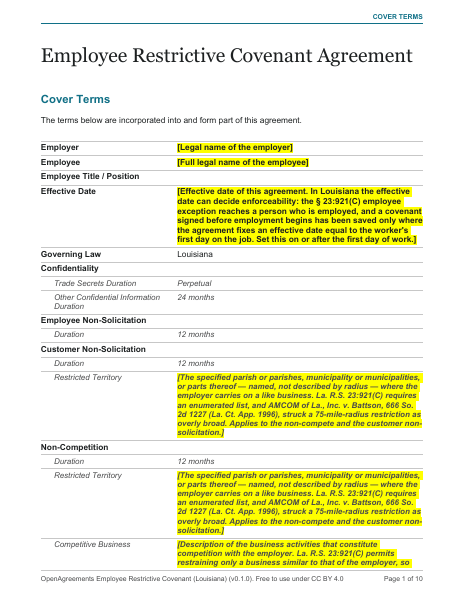 OpenAgreementsEmployee Restrictive Covenant (Louisiana)Louisiana-specific employee restrictive covenant agreement built for La. R.S. 23:921's void-unless-excepted rule: confidentiality and trade-secret protection, a customer non-solicitation and an optional non-compete drawn to fit the § 23:921(C) employee exception (named parishes or municipalities, a like business carried on there, and no more than two years from termination), an employee non-solicitation covenant reviewed under the common-law reasonableness standard, an effective-date recital tying the covenants to the start of employment, physician burn-off caps, occupation carve-outs (automobile salesmen, interns and apprentices, real estate licensees), and a Louisiana-law-and-forum selection — with no judicial reformation, because a non-compliant Louisiana covenant is severed rather than rewritten. Drafted as a starting point for licensed counsel review.
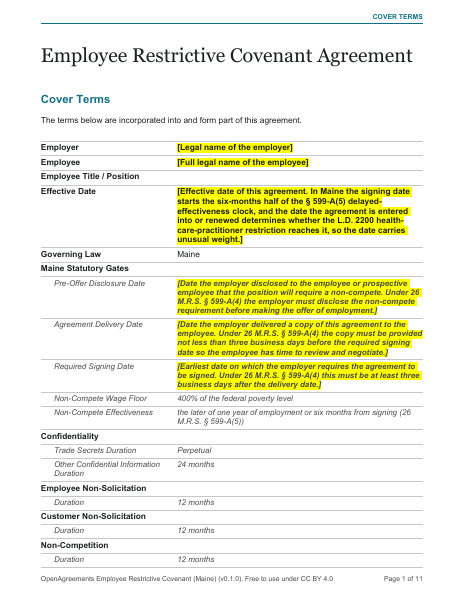 OpenAgreementsEmployee Restrictive Covenant (Maine)Maine-specific employee restrictive covenant agreement built for 26 M.R.S. § 599-A: confidentiality and trade-secret protection tied to the statute's three legitimate business interests (trade secrets, non-trade-secret confidential information, and goodwill), an employee non-solicitation covenant, a customer non-solicitation covenant, and an optional non-compete drawn to Maine's reasonableness standard. The agreement recites the § 599-A(4) pre-offer disclosure and three-business-day review window as statutory duties, states the § 599-A(5) delayed-effectiveness mechanics (no effect until the later of one year of employment or six months from signing, except for allopathic and osteopathic physicians), bars the non-compete at or below the 400% federal-poverty-level wage floor, excludes non-owner veterinarians, flags the L.D. 2200 health-care-practitioner restriction for agreements entered into or renewed on or after July 13, 2026, excludes employer-to- employer no-poach terms under § 599-B, keeps Maine law and a Maine forum for Maine-based workers, and drafts each covenant to the restraint the employer actually intends to enforce rather than relying on discretionary judicial reformation. Drafted as a starting point for licensed counsel review.
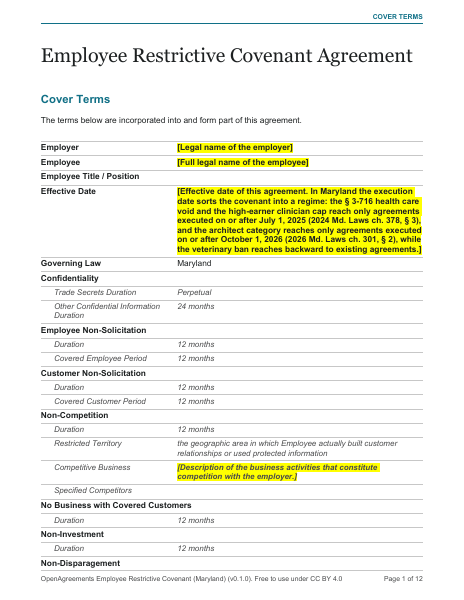 OpenAgreementsEmployee Restrictive Covenant (Maryland)Maryland-specific employee restrictive covenant agreement built for Md. Code, Lab. & Empl. § 3-716: confidentiality and trade-secret protection anchored on the Maryland Uniform Trade Secrets Act, an employee non-solicitation covenant, a customer non-solicitation covenant tied to Maryland's protectable client- relationship interest and the statute's client-list carve-out, and an optional non-compete drawn to the common-law reasonableness standard. The agreement recites the statutory worker-class voids that make a covenant null and void outright for low-wage employees (150% or less of the State minimum wage), veterinary practitioners and technicians, and most direct-patient-care Health Occupations Article licensees earning $350,000 or less, and it caps a covered high-earner clinician covenant at one year and ten miles. Consideration rests on continued at-will employment, and each covenant is drafted in severable tiers for Maryland's strict blue-pencil rule rather than relying on discretionary judicial reformation. Drafted as a starting point for licensed counsel review.
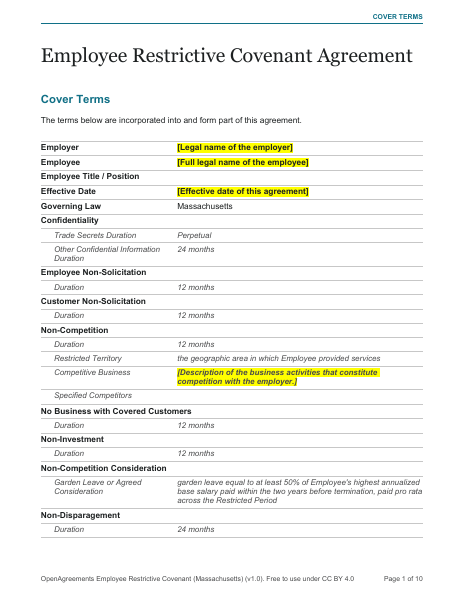 OpenAgreementsEmployee Restrictive Covenant (Massachusetts)Massachusetts-specific employee restrictive covenant agreement with modular covenant structure (non-compete, non-solicitation, non-dealing, non-investment, confidentiality, non-disparagement). Implements the Massachusetts Noncompetition Agreement Act, Mass. Gen. Laws ch. 149, § 24L (garden-leave or other agreed consideration, 12-month duration cap, formation-timing and notice requirements, excluded-worker categories, choice-of-law and § 24L(f) venue limits, and discretionary judicial reformation), and the profession-specific bans of Mass. Gen. Laws ch. 112, §§ 12X/74D/129B/135C and ch. 149, § 186. Generated by projecting the OpenAgreements restrictive covenant master to the Massachusetts overlay; drafted as a starting point for licensed counsel review.
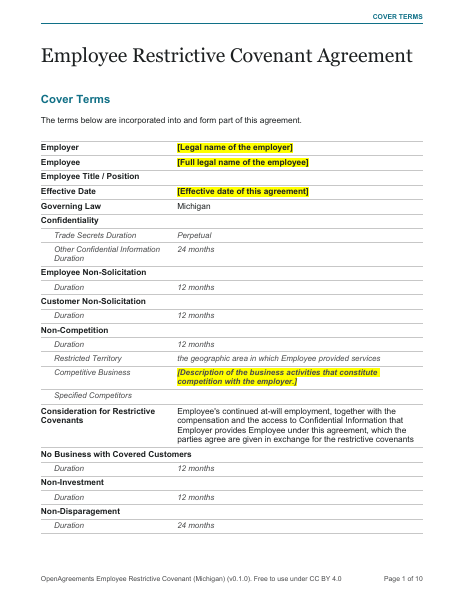 OpenAgreementsEmployee Restrictive Covenant (Michigan)Michigan-specific employee restrictive covenant agreement built for MCL § 445.774a(1): confidentiality and trade-secret protection backstopped by the Michigan Uniform Trade Secrets Act (MCL §§ 445.1901–445.1910), customer and employee non-solicitation, an optional non-compete gated on a reasonable competitive business interest and sized reasonably as to duration, geographic area, and line of business, a consideration recital keyed to Michigan's rule that continued employment supports a covenant only in a genuine at-will setting, a general-knowledge-and-skill carve-out, a paired governing-law and forum-selection provision under which a Michigan court applies Michigan law to the effect of a forum-selection clause, physician proof-of-diversion scrutiny under the physician-patient privilege, and statutory blue-pencil reformation that the drafting does not rely on (MCL § 445.774a(1) empowers a court to limit an unreasonable covenant and enforce it as limited, but the power is discretionary). Drafted as a starting point for licensed counsel review.
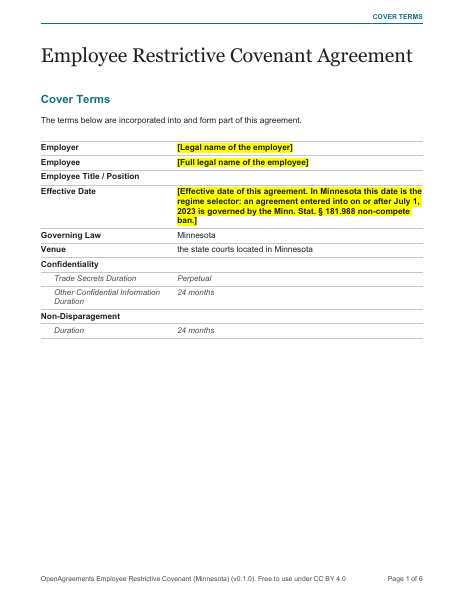 OpenAgreementsEmployee Restrictive Covenant (Minnesota)Minnesota-specific employee restrictive covenant agreement centered on confidentiality, trade secret protection, property return, non-disparagement, and narrowly drafted customer and employee non-solicitation. Omits any employee covenant not to compete under Minn. Stat. section 181.988, subd. 2(a), which makes covenants not to compete void and unenforceable, and preserves only the covenants the statute leaves outside its definition of a covenant not to compete under subd. 1(a) — confidentiality and trade-secret protection, non-disparagement, property return, and customer and employee non-solicitation covenants drafted to reach only customers and colleagues the worker actually dealt with, keyed to Employee-initiated solicitation and a defined Restricted Period, so they protect relationships and information rather than functioning as a restraint on competition. Includes Minnesota choice-of-law and forum language reflecting Minn. Stat. section 181.988, subd. 3. Drafted as a starting point for licensed counsel review.
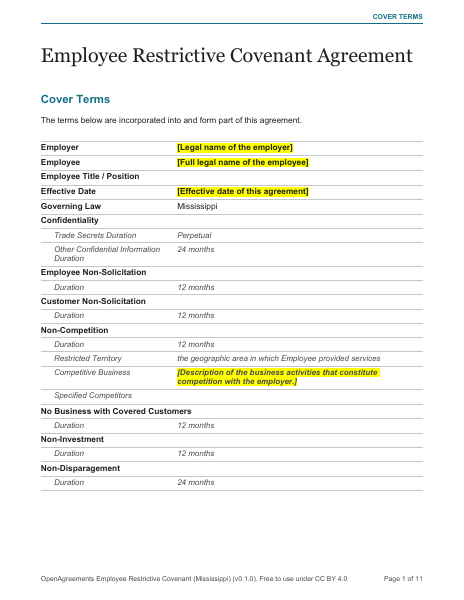 OpenAgreementsEmployee Restrictive Covenant (Mississippi)Mississippi-specific employee restrictive covenant agreement built for Mississippi's common-law reasonableness regime: there is no general Mississippi non-compete statute, so every post-employment restraint stands or falls on the three-interest reasonableness balance the courts weigh — the rights of the employer, the rights of the employee, and the rights of the public — with the enforcing employer carrying the burden and the disfavored covenant construed strictly against the drafter. It provides confidentiality and trade-secret protection independent of any covenant, a continued-at-will-employment consideration recital, customer and employee non-solicitation, an optional non-dealing covenant using the express no-acceptance language a customer-facing restraint needs, an optional non-compete tied to a legitimate protectable interest and sized to the employee's real influence, an express extension-on-breach tolling clause because Mississippi courts do not extend the restricted period on their own but give an express extension clause effect, express and pre-departure assignment to successors, a no-enforcement term for covenants invoked after an arbitrary, capricious, or bad-faith termination, a lawyer practice-restriction exclusion (Miss. R. Prof'l Conduct 5.6), and discretionary equitable reformation that the drafting does not rely on. Drafted as a starting point for licensed counsel review.
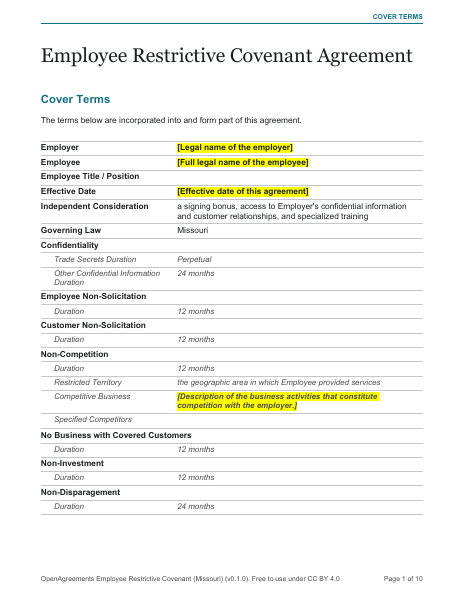 OpenAgreementsEmployee Restrictive Covenant (Missouri)Missouri-specific employee restrictive covenant agreement built for Missouri's common-law reasonableness regime: there is no general Missouri non-compete statute, so every post-employment restraint begins as a presumptively void restraint on trade and is enforceable only to the extent it is demonstrably reasonable AND protects the employer's trade secrets or customer contacts — never mere competition, with the employer bearing the burden on the protectable interest and on time/geographic reasonableness. It provides confidentiality and trade-secret protection backstopped by the Missouri Uniform Trade Secrets Act (Mo. Rev. Stat. §§ 417.453, 417.455), an independent-consideration recital reflecting Missouri's divided consideration law, a customer non-solicitation covenant narrowed to serviced customers rather than the whole customer book, an employee non-solicitation covenant drawn to the one-year conclusive-presumption safe harbor of Mo. Rev. Stat. § 431.202, an optional non-compete tied to the identified trade-secret or customer-contact interest and sized to the actual footprint, a tolling clause flagged as an open Missouri question, physician covenants held to the ordinary reasonableness standard (Missouri has no physician-specific statute), and discretionary judicial modification that the drafting does not rely on (Missouri case law permits modification but treats it as discretionary and prices overreach through the prevailing-party fee rule). Drafted as a starting point for licensed counsel review.
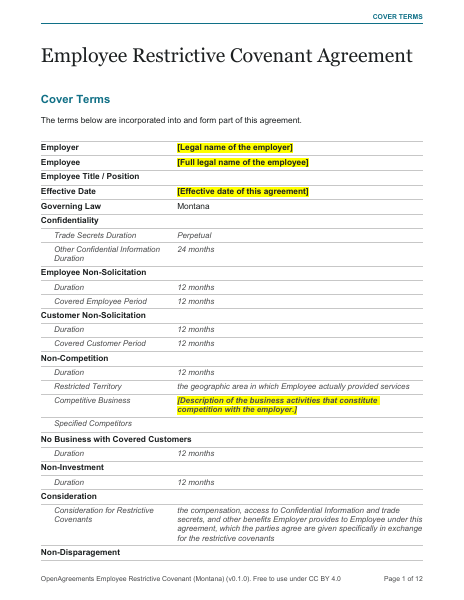 OpenAgreementsEmployee Restrictive Covenant (Montana)Montana-specific employee restrictive covenant agreement built for Mont. Code Ann. § 28-2-703, where any restraint on a lawful profession, trade, or business is void except a reasonable partial restraint: confidentiality and trade-secret protection, customer and employee non-solicitation drawn as partial restraints, an optional non-compete drawn to Montana's three-part reasonableness test, an independent-consideration recital for post-hire covenants, an employer-initiated-termination acknowledgement, the phased § 28-2-724 health-care provider exclusion, distinct severable promises in place of judicial reformation, and the §§ 28-2-704/705 sale-of-goodwill and partnership-dissolution exception framework. Drafted as a starting point for licensed counsel review.
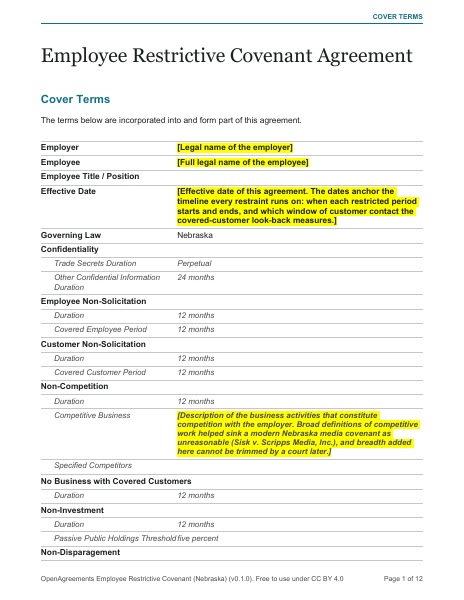 OpenAgreementsEmployee Restrictive Covenant (Nebraska)Nebraska-specific employee restrictive covenant agreement built for Nebraska's strict common-law reasonableness regime: there is no general Nebraska non-compete statute, so every post-employment restraint stands or falls on the three-part common-law reasonableness test (not injurious to the public, no greater than reasonably necessary to protect a legitimate employer interest, not unduly harsh and oppressive on the employee). The defining constraint is Nebraska's customer-specific rule: a covenant protecting customer goodwill may be valid only if limited to clients and accounts the worker actually did business with and personally contacted — a rule a 2024 federal decision enforced to reject a non-solicit reaching prospective customers. Nebraska courts do NOT blue-pencil or reform overbroad employment covenants, and nonseverable integrated restraints fall together, so each covenant is drafted self-contained, severable, and scoped to personally served customers from the start rather than in reliance on judicial narrowing. It provides confidentiality and trade-secret protection backstopped by the Nebraska Trade Secrets Act (Neb. Rev. Stat. §§ 87-501 to 87-507), a customer non-solicitation limited to personally served customers, an optional non-compete tied to that same customer set rather than a market or territory, express merger-by-operation-of-law and assignment terms, and a Nebraska-first choice-of-law posture. Drafted as a starting point for licensed counsel review.
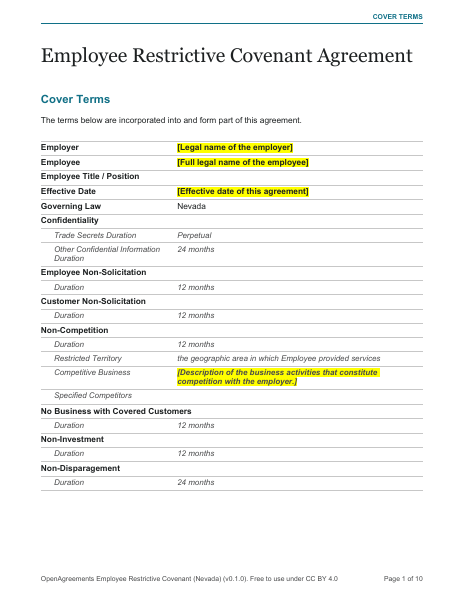 OpenAgreementsEmployee Restrictive Covenant (Nevada)Nevada-specific employee restrictive covenant agreement built for NRS 613.195 and NRS 613.200: confidentiality and trade-secret protection kept inside the NRS 613.200(4) safe harbor, customer and employee non-solicitation, an optional non-compete drawn to the NRS 613.195(1) four-part validity test with the categorical exclusion of solely hourly-paid workers, the volunteer-customer service carve-out, the post-restructuring continued-pay condition, an acknowledgement of Nevada's mandatory judicial revision regime, and express-consent mechanics for an asset-sale assignment. Drafted as a starting point for licensed counsel review.
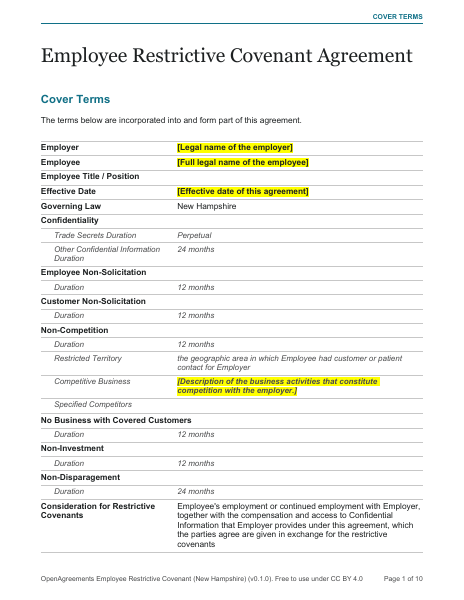 OpenAgreementsEmployee Restrictive Covenant (New Hampshire)New Hampshire-specific employee restrictive covenant agreement built for the state's three-part reasonableness test and its statutory traps: confidentiality and trade-secret protection under RSA chapter 350-B, customer and employee non-solicitation tied to the employee's own sphere of customer goodwill, an optional non-compete drawn to the recognized protectable interests, the RSA 275:70 pre-acceptance delivery recital for new hires, the RSA 275:70-a low-wage exclusion, the clinician geographic-practice carve-out (RSA 329:31-a, 326-B:45-a, 326-B:45-b, 315:18), and a good-faith-preserving, drawn-narrow reformation posture rather than reliance on judicial repair. Drafted as a starting point for licensed counsel review.
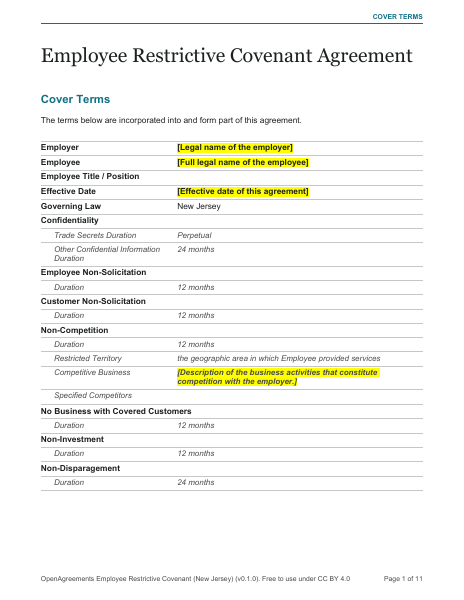 OpenAgreementsEmployee Restrictive Covenant (New Jersey)New Jersey-specific employee restrictive covenant agreement built for New Jersey's common-law reasonableness regime: there is no general New Jersey non-compete statute for the ordinary workforce, so every post-employment restraint stands or falls on the three-part common-law reasonableness test (protects the employer's legitimate interests, imposes no undue hardship on the employee, and is not injurious to the public). It provides confidentiality and trade-secret protection backstopped by the New Jersey Trade Secrets Act (N.J.S.A. 56:15-1 et seq.), a continued-employment consideration recital, customer and employee non-solicitation, an optional non-compete tied to identified legitimate interests and sized to the actual footprint, a breach-tied tolling clause, physician public-interest scrutiny, and partial enforcement that works with the grain of the doctrine. It carves out the discrimination-claim concealment bar (N.J.S.A. 10:5-12.8) and disclaims practice restrictions for lawyers (RPC 5.6) and client-access restrictions for psychologists (N.J.A.C. 13:42-10.16). Drafted as a starting point for licensed counsel review.
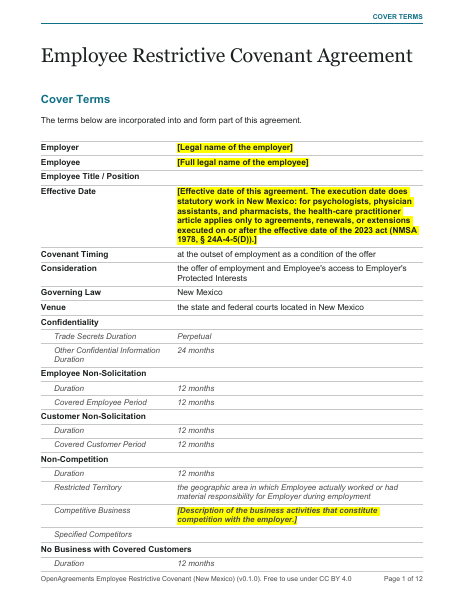 OpenAgreementsEmployee Restrictive Covenant (New Mexico)New Mexico-specific employee restrictive covenant agreement built for the common-law reasonableness standard and the health-care practitioner statute (NMSA 1978, §§ 24A-4-1 to 24A-4-5): confidentiality and trade-secret protection tied to a specific legitimate interest, an employee non-solicitation covenant, a customer non-solicitation covenant, and an optional non-compete drawn to reasonableness in time, geography, and scope rather than copied from a form. The agreement documents independent new consideration for a covenant signed after employment begins, because New Mexico treats continued at-will employment as illusory. It excludes non-competes for the ten covered health-care practitioner classes, holds the surviving practitioner fallbacks — one-year patient and employee non-solicits, early-departure repayment, NDAs, and reasonable liquidated damages — within their statutory bounds, keeps New Mexico law and a New Mexico forum for agreements covering clinical health-care services rendered in the state, and secures narrowing through an express reformation clause because New Mexico's only identified reformation authority is contract-based. Drafted as a starting point for licensed counsel review.
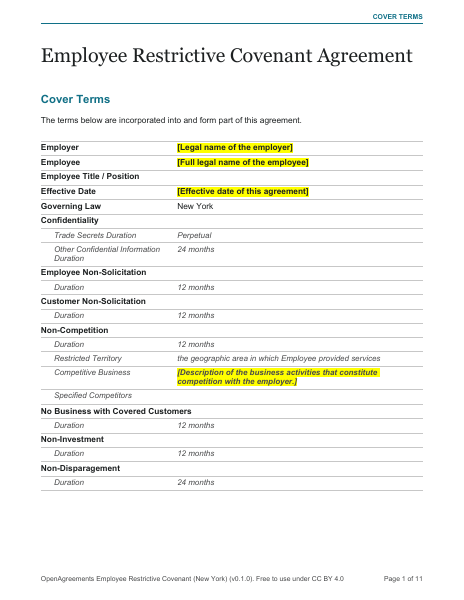 OpenAgreementsEmployee Restrictive Covenant (New York)New York-specific employee restrictive covenant agreement built for New York's common-law reasonableness regime: there is no general New York non-compete statute, so every post-employment restraint stands or falls on the three-pronged common-law reasonableness test, and a single failed prong invalidates the covenant. It provides confidentiality and trade-secret protection, a continued-employment consideration recital, customer and employee non-solicitation with the customer non-solicit narrowed to customers the employee actually served, an optional non-compete tied to New York's short list of recognized protectable interests, a broadcast-employee exclusion under N.Y. Labor Law § 202-k, a sale-of-business covenant aligned with New York's implied goodwill covenant, a governing-law clause drafted against New York's public-policy limit on foreign choice-of-law, and a drafting posture that sizes each covenant to the protectable interest rather than relying on discretionary partial enforcement. Drafted as a starting point for licensed counsel review.
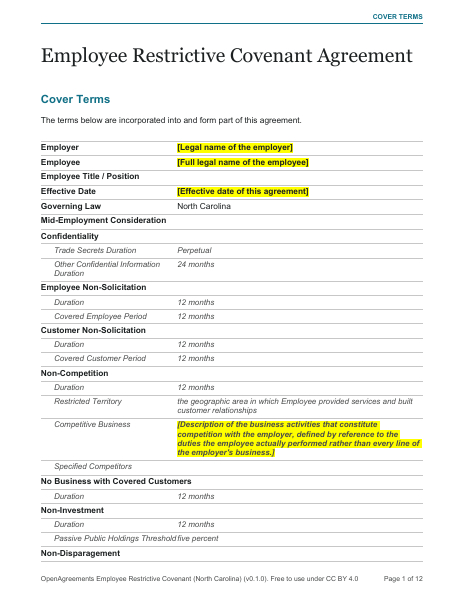 OpenAgreementsEmployee Restrictive Covenant (North Carolina)North Carolina-specific employee restrictive covenant agreement built for North Carolina's common-law reasonableness regime with a strict-severance twist: there is no general North Carolina non-compete statute, so every post-employment restraint stands or falls on the five-element common-law test — in writing, part of an employment contract, based on valuable consideration, reasonable as to time and territory, and designed to protect a legitimate business interest and not against public policy — read strictly against the drafter against the backdrop of N.C. Gen. Stat. § 75-1's declaration that contracts in restraint of trade are illegal. It provides confidentiality and trade-secret protection backstopped by the North Carolina Trade Secrets Protection Act (N.C. Gen. Stat. §§ 66-152, 66-154), a new-consideration recital for mid-employment covenants, a § 75-4 signed-writing acknowledgement keyed to the employee's signature, customer and employee non-solicitation confined to actual relationships, an optional non-compete confined to the employee's actual duties and customer territory, an express extension-on-breach tolling clause, physician public-health scrutiny, an in-state forum required by N.C. Gen. Stat. § 22B-3, and severable, tiered covenants that do not rely on judicial reformation because North Carolina follows the strict blue-pencil doctrine under which a court may strike but never rewrite. Drafted as a starting point for licensed counsel review.
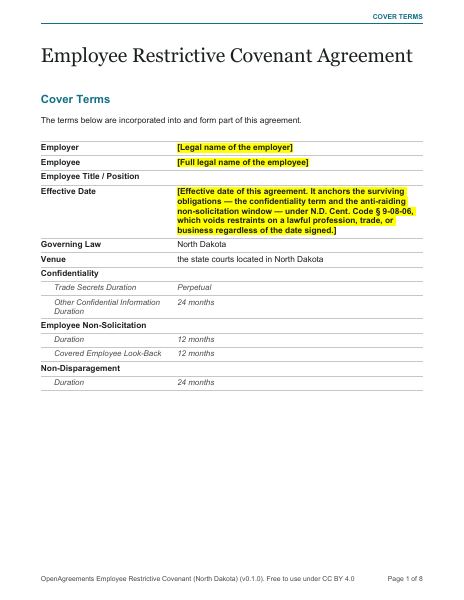 OpenAgreementsEmployee Restrictive Covenant (North Dakota)North Dakota-specific employee restrictive covenant agreement centered on confidentiality, trade secret protection, property return, non-disparagement, and a narrowly drafted anti-raiding employee non-solicitation covenant. Omits any employee covenant not to compete, any customer non-solicitation covenant, and any non-dealing covenant, because N.D. Cent. Code § 9-08-06 makes a contract that restrains a lawful profession, trade, or business to that extent void, and North Dakota case law treats post-employment customer solicitation and replacement restrictions as void with no statutory exception. It preserves only the covenants North Dakota law leaves enforceable — confidentiality and trade-secret protection under N.D. Cent. Code ch. 47-25.1, non-disparagement, property return, and a narrow anti-raiding employee non-solicitation covenant North Dakota case law treats as not void as a restraint of trade — each drawn to reach only Covered Employees the worker actually dealt with, keyed to Employee-initiated solicitation and a defined Restricted Period, so it protects the workforce and information rather than functioning as a restraint on competition. Includes North Dakota choice-of-law and forum language reflecting North Dakota public policy against enforcing a non-compete through a foreign choice-of-law or forum selection and N.D. Cent. Code § 28-04.1-03. Drafted as a starting point for licensed counsel review.
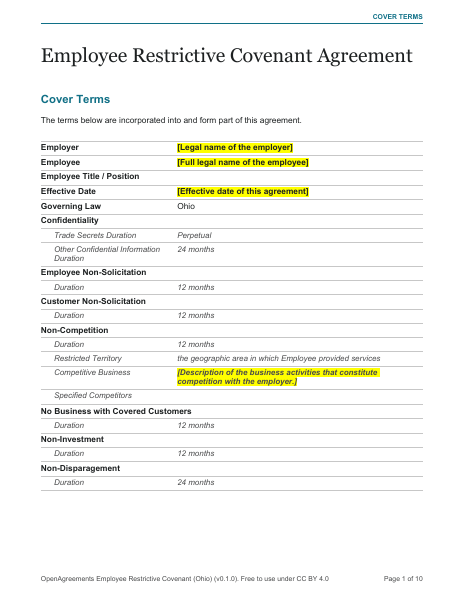 OpenAgreementsEmployee Restrictive Covenant (Ohio)Ohio-specific employee restrictive covenant agreement built for Ohio's common-law reasonableness regime: there is no general Ohio non-compete statute, so every post-employment restraint stands or falls on the three-part reasonableness test (no greater than required to protect the employer, no undue hardship on the employee, not injurious to the public). It provides confidentiality and trade-secret protection under the Ohio Uniform Trade Secrets Act (R.C. 1333.61-1333.69), a continued-at-will-employment consideration recital, customer and employee non-solicitation, an optional non-compete tied to identified protectable interests and sized to the actual footprint, a litigation-extension tolling clause, express assignment beyond a statutory merger, heightened public-interest scrutiny for physician covenants, and discretionary judicial reformation that the drafting does not rely on. Drafted as a starting point for licensed counsel review.
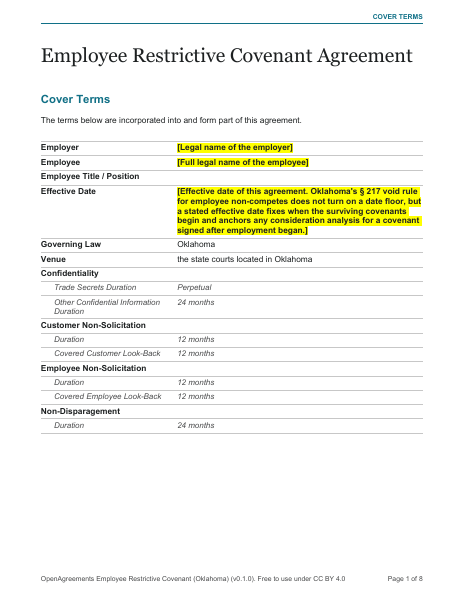 OpenAgreementsEmployee Restrictive Covenant (Oklahoma)Oklahoma-specific employee restrictive covenant agreement centered on confidentiality, trade secret protection, property return, non-disparagement, and narrowly drafted customer and employee non-solicitation. Omits any employee covenant not to compete, because Okla. Stat. tit. 15, § 217 voids every contract restraining a person from exercising a lawful profession, trade, or business of any kind, save for the narrow statutory carve-outs in §§ 218-219 (sale of goodwill and partnership dissolution) and §§ 219A-219B. The agreement preserves only the covenants those sections leave standing for an employee: a customer non-solicitation covenant drafted to reach only the direct solicitation of the sale of goods or services from the former employer's established customers, as § 219A(A) permits and no further; an employee anti-raiding covenant that § 219B removes from the restraint-of-trade prohibition; and confidentiality, trade-secret, property-return, and non-disparagement obligations that restrain the misuse of information rather than the exercise of a trade. Both non-solicits are keyed to a defined Restricted Period and expressly disclaim any bar on Employee working for a competitor. Drafted as a starting point for licensed counsel review.
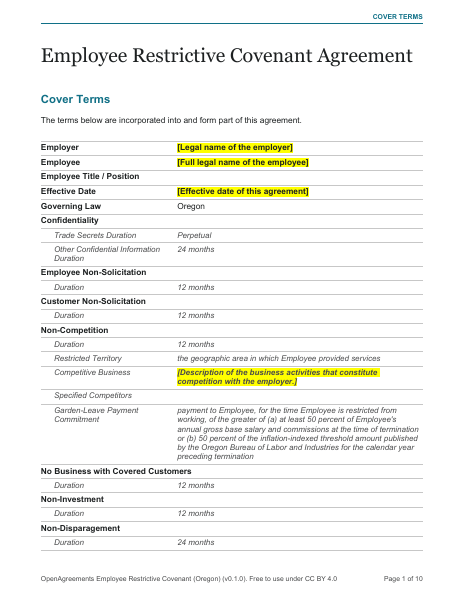 OpenAgreementsEmployee Restrictive Covenant (Oregon)Oregon-specific employee restrictive covenant agreement built for ORS 653.295's void-unless regime: confidentiality and trade-secret protection, customer and employee non-solicitation and non-dealing covenants that fall outside the statutory checklist, and an optional non-compete gated on the two-week written-offer notice or bona fide advancement, exempt-salaried status above the inflation-indexed salary threshold, a statutory protectable interest, the 12-month cap, and delivery of a signed copy within 30 days after termination, with a garden-leave pay-to-enforce alternative for sub-threshold workers, the 2025 medical-licensee ban, the Workplace Fairness Act carve-out, and a draft-within-the-statute posture rather than reliance on judicial reformation. Drafted as a starting point for licensed counsel review.
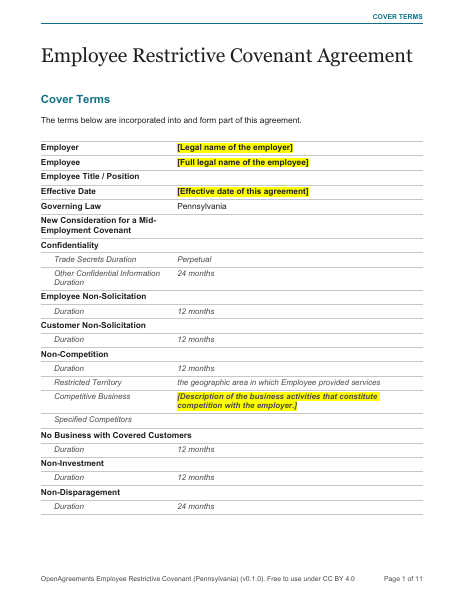 OpenAgreementsEmployee Restrictive Covenant (Pennsylvania)Pennsylvania-specific employee restrictive covenant agreement built for Pennsylvania's common-law reasonableness regime: there is no general Pennsylvania non-compete statute, so every post-employment restraint stands or falls on Pennsylvania's four-part common-law test — ancillary to an employment relationship, supported by adequate consideration, reasonably limited in duration and geography, and tied to a legitimate protectable interest. It provides confidentiality and trade-secret protection, a new-consideration recital for a covenant signed after employment begins that does not lean on a Uniform Written Obligations Act recital, customer and employee non-solicitation drafted as affirmative-outreach restraints with a geographic limit, an optional non-compete tied to identified protectable interests and sized to the actual footprint under close scrutiny, a health care practitioner clause reflecting the Fair Contracting for Health Care Practitioners Act (Act 74 of 2024) one-year cap, dismissal rule, and 90-day patient-notice duty, an express assignability provision the covenant needs to reach a buyer, and separable, tiered restraints that do not rely on discretionary judicial reformation. Drafted as a starting point for licensed counsel review.
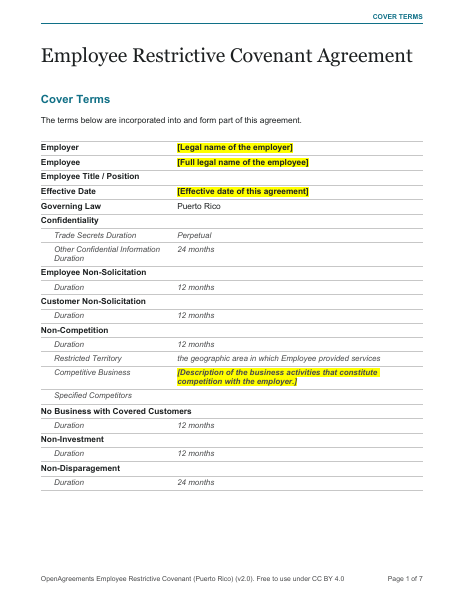 OpenAgreementsEmployee Restrictive Covenant (Puerto Rico)Puerto Rico-specific employee restrictive covenant agreement with modular covenant structure. Reflects the twelve-month maximum and reasonableness requirements described in Arthur Young & Co. v. Vega, 136 D.P.R. 157 (1994). Drafted as a starting point for review by licensed Puerto Rico counsel.
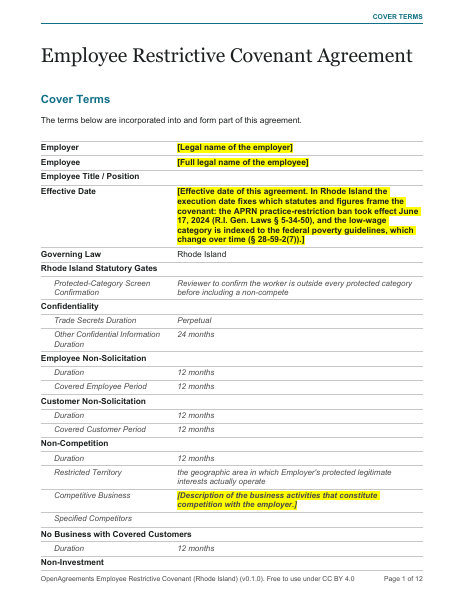 OpenAgreementsEmployee Restrictive Covenant (Rhode Island)Rhode Island-specific employee restrictive covenant agreement built for the Rhode Island Noncompetition Agreement Act (R.I. Gen. Laws ch. 28-59) and the common-law reasonableness regime: confidentiality and trade-secret protection preserved by the act, an employee non-solicitation covenant, a customer non-solicitation covenant, and an optional non-compete drafted to the state's strict-scrutiny reasonableness standard. The act bans non-competes outright for four protected worker categories — employees who are FLSA-nonexempt, undergraduate or graduate student interns, workers age 18 or younger, and low-wage employees earning not more than 250 percent of the federal poverty level for individuals — and separate statutes void any restriction of a physician's or an advanced practice registered nurse's right to practice. Employee and customer non-solicits and confidentiality agreements are excluded from the statutory non-compete definition, so each restraint is drafted as the covenant type it actually is and runs through common law. The agreement recites the common-law enforcement elements, permits partial enforcement while drawing each covenant no broader than reasonably necessary, and relies on trade-secret protection as the fallback the act preserves. Drafted as a starting point for licensed counsel review.
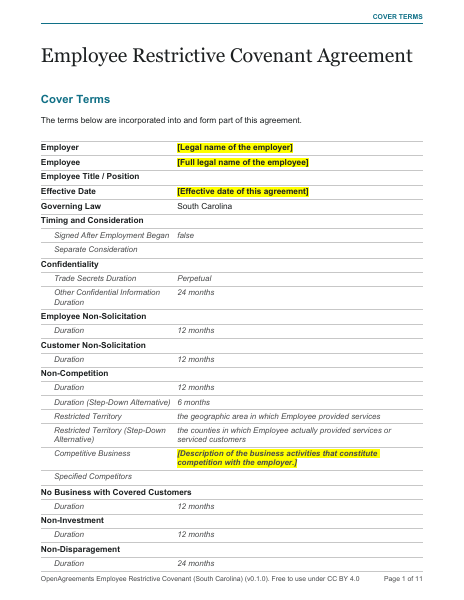 OpenAgreementsEmployee Restrictive Covenant (South Carolina)South Carolina-specific employee restrictive covenant agreement built for South Carolina's common-law reasonableness regime: there is no general South Carolina non-compete statute, so every post-employment restraint stands or falls on a conjunctive five-factor reasonableness test — necessary to protect a legitimate interest, reasonably limited in time and place, not unduly harsh and oppressive, reasonable from the standpoint of sound public policy, and supported by valuable consideration — with the covenant disfavored as a restraint of trade and strictly construed against the employer. It provides confidentiality and trade-secret protection backstopped by the South Carolina Trade Secrets Act (S.C. Code Ann. § 39-8-30), a separate-consideration recital for covenants signed after employment begins, customer and employee non-solicitation scoped to the worker's own relationships, a non-compete tied to identified protectable interests and sized to the actual footprint, a time-limited confidentiality term so nondisclosure does not operate as an untimed non-compete, and tiered, self-contained step-down covenants rather than any reliance on judicial reformation, because South Carolina courts neither blue-pencil nor reform an overbroad covenant and extension past a stated end date is against public policy. Drafted as a starting point for licensed counsel review.
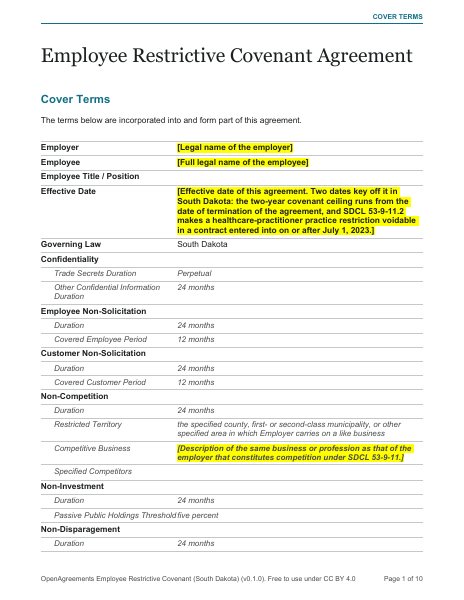 OpenAgreementsEmployee Restrictive Covenant (South Dakota)South Dakota-specific employee restrictive covenant agreement built for the SDCL chapter 53-9 statutory whitelist: confidentiality and trade-secret protection, a customer non-solicitation limited to existing customers, and an optional non-compete drawn to the § 53-9-11 employee exception — the same business or profession, a specified county, first- or second-class municipality, or other specified area, a two-year ceiling measured from the date of termination of the agreement, and the like-business condition. Customer restrictions are confined to solicitation, not acceptance, and each covenant is drafted to survive a fixed-term agreement expressly. Drafted as a starting point for licensed counsel review.
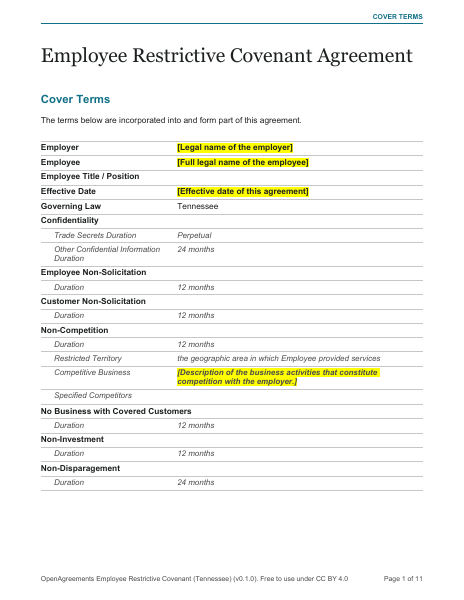 OpenAgreementsEmployee Restrictive Covenant (Tennessee)Tennessee-specific employee restrictive covenant agreement built for Tennessee's common-law reasonableness regime and its 2026 statutory overlay. Covenants not to compete are enforceable only when they protect special facts over and above ordinary competition and stay reasonable in time, territory, and scope under Tennessee's common-law factors. On top of that, 2026 Tenn. Pub. Acts ch. 934 (Tenn. Code Ann. §§ 50-1-210, 50-1-211), effective July 1, 2026, voids a non-compete against an employee earning under $70,000, presumes overlong time restraints unreasonable by relationship type, and expressly preserves confidentiality and customer and employee non-solicitation covenants. It provides confidentiality and trade-secret protection under the Tennessee Uniform Trade Secrets Act (Tenn. Code Ann. §§ 47-25-1701 to 47-25-1709), a continued-employment consideration recital, customer and employee non-solicitation, an optional non-compete drawn to the reasonableness test and the statutory threshold, the § 63-1-148 health-care-provider safe harbor with its emergency-medicine exclusion, good-faith choice of law, and discretionary judicial reformation under the rule of reasonableness that the drafting does not rely on. Drafted as a starting point for licensed counsel review.
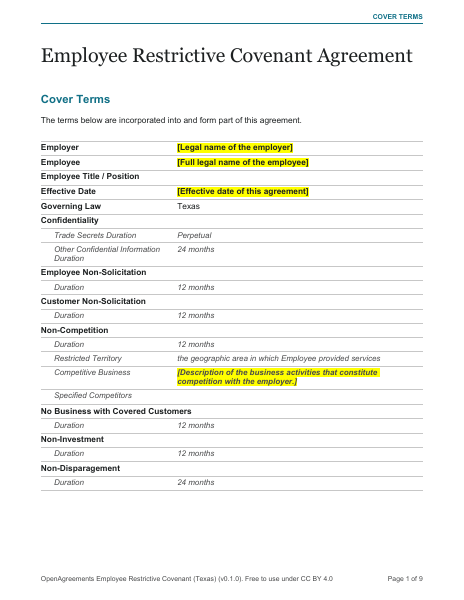 OpenAgreementsEmployee Restrictive Covenant (Texas)Texas-specific employee restrictive covenant agreement built for the Texas Covenants Not to Compete Act (Tex. Bus. & Com. Code sections 15.50-15.52): confidentiality and trade-secret protection, an ancillary-to-an-otherwise-enforceable-agreement consideration recital, customer non-solicitation and an optional non-compete drafted to reasonable time, area, and scope, physician and health-care-practitioner buyout terms, and Texas choice-of-law and forum language. Drafted as a starting point for licensed counsel review.
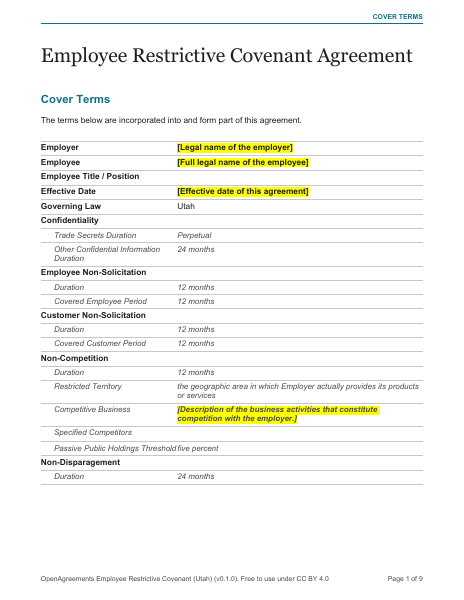 OpenAgreementsEmployee Restrictive Covenant (Utah)Utah-specific employee restrictive covenant agreement built for the Utah Post-Employment Restrictions Act (Utah Code sections 34-51-101 through 34-51-301) and the common-law reasonableness test: confidentiality and trade-secret protection under the Utah Uniform Trade Secrets Act, customer and employee non-solicitation (expressly outside the statutory non-compete definition and its one-year cap), and an optional non-compete capped at one year from separation and drawn to the four-part reasonableness test. Reflects the statutory void consequence for over-length covenants, the section 34-51-301 employer fee-shifting exposure, the sale-of-business and severance exemptions, and the 2026 healthcare-worker and veterinarian bans. Drafted as a starting point for licensed counsel review.
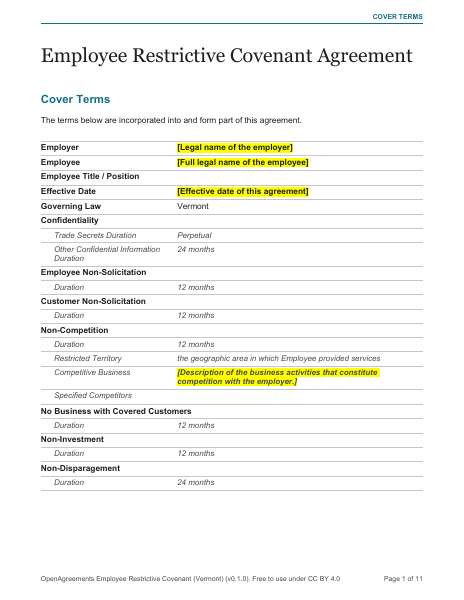 OpenAgreementsEmployee Restrictive Covenant (Vermont)Vermont-specific employee restrictive covenant agreement built for Vermont's common-law reasonableness regime: there is no general Vermont non-compete statute, so every post-employment restraint stands or falls on the common-law reasonableness test (enforcement is ordered unless the covenant is contrary to public policy, unnecessary for the employer's protection, or unnecessarily restrictive of the employee), framed by the courts through Restatement (Second) of Contracts § 188(1). It provides confidentiality and trade-secret protection backstopped by the Vermont Trade Secrets Act (9 V.S.A. §§ 4602-4603), a continued-at-will-employment consideration recital, customer and employee non-solicitation, an optional non-compete tied to identified protectable interests and sized to the actual footprint, an express tolling clause the drafting does not assume a court will supply, profession-specific exclusions for barbering/cosmetology trainees (26 V.S.A. § 281(c)) and lawyers (Vt. R. Prof. Conduct 5.6), healthcare-professional reasonableness scrutiny without assuming a statutory healthcare ban, and an ordinary severability clause the drafting treats as a backstop rather than a narrowing strategy because Vermont court narrowing is unsettled (the case law bars equitable rewriting of the time term while other decisions carry partial-enforcement dicta). Drafted as a starting point for licensed counsel review.
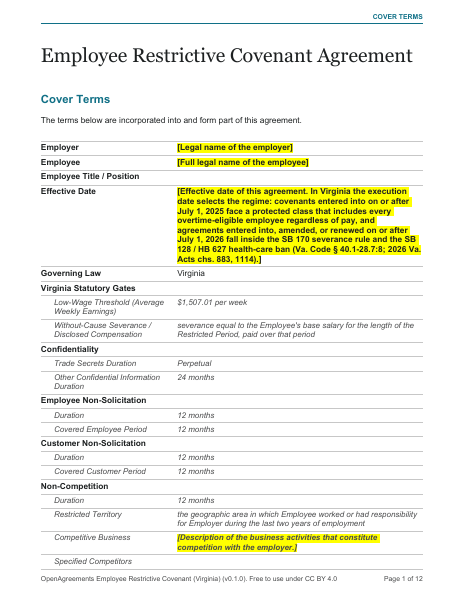 OpenAgreementsEmployee Restrictive Covenant (Virginia)Virginia-specific employee restrictive covenant agreement built for Va. Code § 40.1-28.7:8 and Virginia's strict common-law reasonableness test: confidentiality and trade-secret protection with the statutory nondisclosure carve-out preserved, an employee non-solicitation covenant that defaults off because it is presumptively unenforceable against a protected worker, a customer non-solicitation covenant confined to the worker's own solicitation so customer-initiated business stays open, and an optional non-compete confined to the worker's own role and territory. The agreement runs the statutory worker-protection gates before any covenant, states the without-cause severance-or-disclosed-compensation economics SB 170 requires for agreements entered into, amended, or renewed on or after July 1, 2026, excludes health care professionals, and — because Virginia courts do not rewrite an overbroad covenant — draws each covenant within its enforceable scope at the outset rather than relying on judicial reformation. Drafted as a starting point for licensed counsel review.
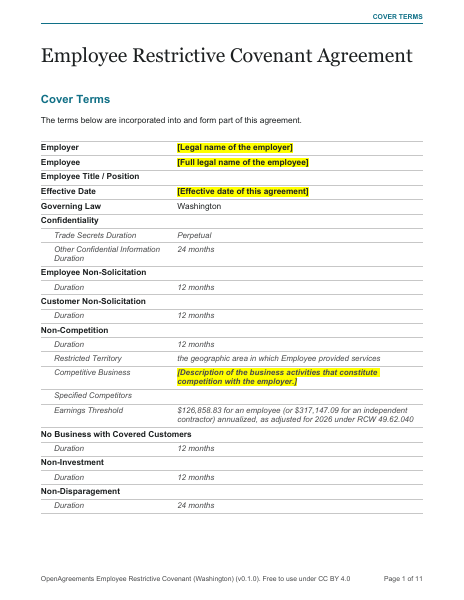 OpenAgreementsEmployee Restrictive Covenant (Washington)Employee restrictive covenant agreement for Washington State, built for chapter 49.62 RCW as amended by SSB 5935 (effective 2024): confidentiality and trade-secret protection, customer and employee non-solicitation held to the statutory solicitation-only definition, and an optional non-compete gated on the inflation-adjusted earnings threshold ($126,858.83 for employees / $317,147.09 for independent contractors in 2026 per the Department of Labor & Industries), the at-hire written disclosure or post-hire independent consideration requirement, the eighteen-month duration presumption, and the layoff garden-leave-pay condition. Governing law, venue, and choice of law are locked to Washington for Washington-based workers under RCW 49.62.050, and the agreement flags the June 30, 2027 near-total ban under ESHB 1155 and the October 1, 2027 deadline for employers to make reasonable efforts to give written notice to affected employees and independent contractors that their non-competes are void and unenforceable. Because RCW 49.62.080(3) penalizes judicial reformation until ESHB 1155 deletes that penalty effective June 30, 2027, each covenant is drawn to the minimum the legitimate interest requires. Drafted as a starting point for licensed counsel review.
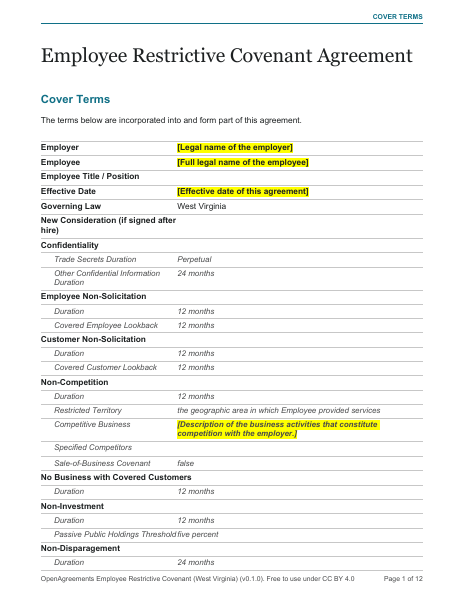 OpenAgreementsEmployee Restrictive Covenant (West Virginia)West Virginia-specific employee restrictive covenant agreement built for West Virginia's common-law reasonableness regime with its facial-overbreadth void trap: there is no general West Virginia non-compete statute, so every post-employment restraint stands or falls on a two-stage common-law inquiry — the employer must first show an interest requiring protection, and the restraint is then reasonable only if it is no greater than required for the employer's protection, imposes no undue hardship on the employee, and is not injurious to the public. A covenant unreasonable on its face is utterly void with no partial enforcement, so the drafting does not rely on a savings or reformation clause to cure overbreadth. It provides confidentiality and trade-secret protection backstopped by the West Virginia Uniform Trade Secrets Act (W. Va. Code §§ 47-22-4, 47-22-7), a new-consideration recital for covenants signed after employment begins, customer restrictions drafted as true non-piracy provisions, employee non-solicitation, an optional non-compete tied to identified protectable interests and sized to the actual footprint, a sale-of-business acknowledgement under the lesser-scrutiny standard, and physician covenant limits capped at one year and thirty road miles with voidness on employer termination (W. Va. Code § 47-11E-1 to -5). Drafted as a starting point for licensed counsel review.
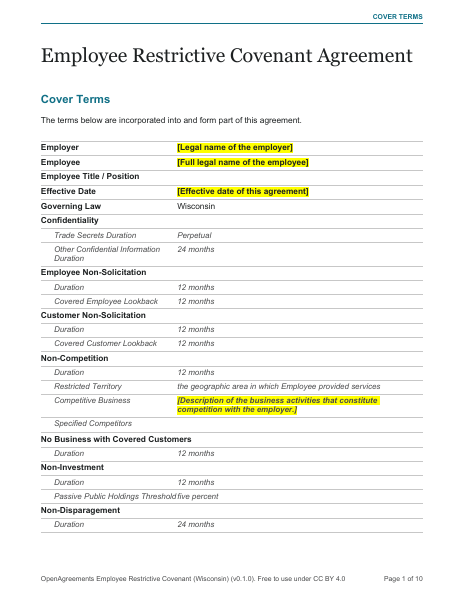 OpenAgreementsEmployee Restrictive Covenant (Wisconsin)Wisconsin-specific employee restrictive covenant agreement built for Wis. Stat. § 103.465, where a covenant is enforceable only if reasonably necessary to protect the employer, a five-factor reasonableness test governs every post-employment restraint, and an unreasonable restraint is void in full with no judicial blue-penciling. Confidentiality and trade-secret protection scoped to protectable information, customer and employee non-solicitation (the employee no-poach limited to actual working relationships), an optional non-compete drawn to the five-factor reasonableness standard, a consideration recital resting on genuine forbearance, no extension-during-breach tolling that would void the restraint, Wisconsin governing law rather than a foreign choice-of-law clause, and divisible covenants in place of reliance on reformation. Drafted as a starting point for licensed counsel review.
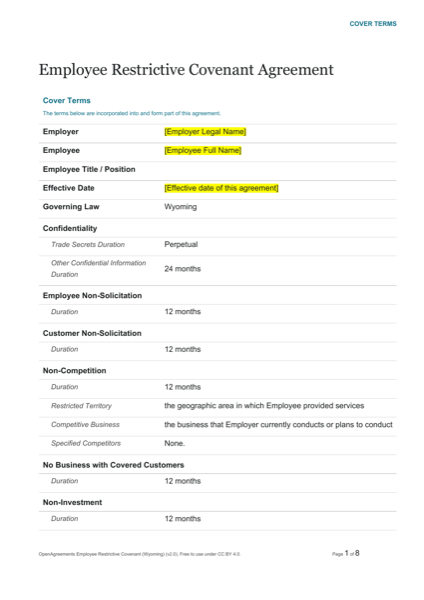 OpenAgreementsEmployee Restrictive Covenant (Wyoming)Wyoming-specific employee restrictive covenant agreement with modular covenant structure (non-compete, non-solicitation, non-dealing, non-investment, confidentiality, non-disparagement). Incorporates Wyo. Stat. section 1-23-108 (SF 107, 2025) pathway gating for non-compete-adjacent covenants. Drafted as a starting point for review by licensed counsel.
View all 53 Non-Competes / Restrictive Covenants templates49 more
Invention - Assignment
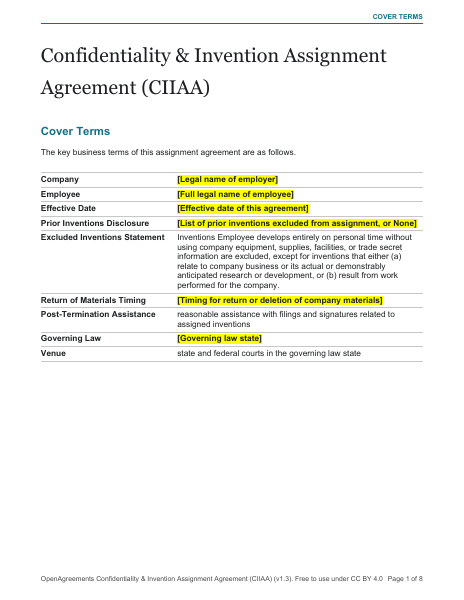 OpenAgreementsConfidential Information and Invention Assignment Agreement (CIIAA)Employee proprietary information and inventions assignment agreement with explicit prior-inventions and personal-project carveout language placeholders.
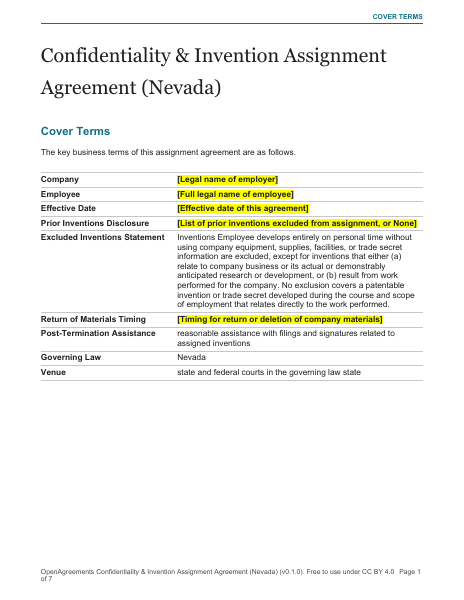 OpenAgreementsConfidential Information and Invention Assignment Agreement (Nevada)Nevada-specific employee confidentiality and invention assignment agreement aligned with Nevada's employer-ownership default (NRS 600.500): the employer keeps statutory ownership of patentable inventions and trade secrets developed in the course and scope of employment that relate directly to the work, the own-time carve-out reaches only inventions outside that statutory grant, and the form carries no state carve-out notice because Nevada imposes none. The assignment clause keeps present-tense assignment language for a clean federal patent chain of title and carries no post-employment holdover tail. Drafted as a starting point for licensed counsel review.
Confidentiality / NDA
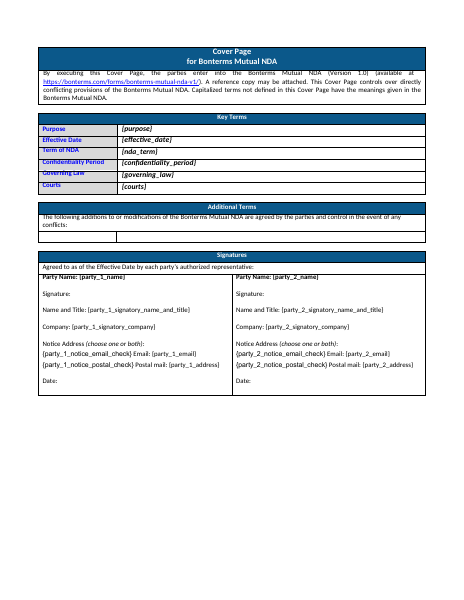 BontermsMutual NDACover page for the Bonterms Mutual NDA (Version 1.0). The standard terms are incorporated by reference from bonterms.com.
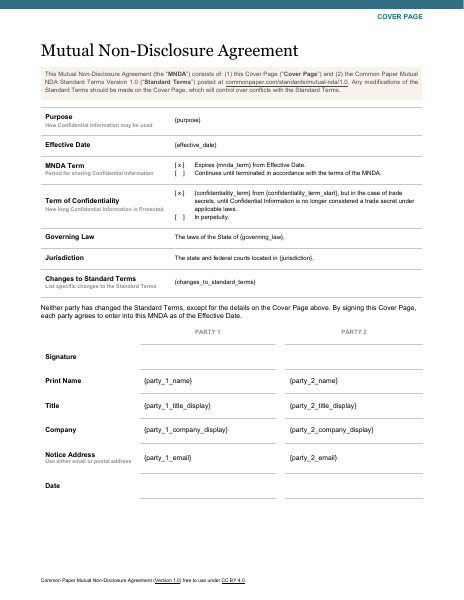 Common PaperMutual NDAA mutual non-disclosure agreement cover page based on Common Paper's standard terms. The cover page references the Standard Terms posted at commonpaper.com.
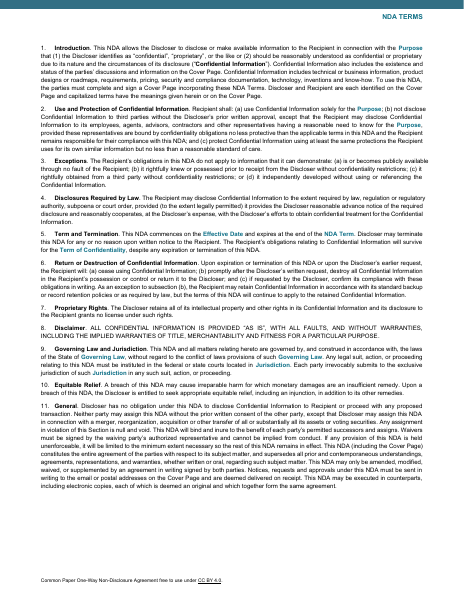 Common PaperOne-Way NDAA one-way (unilateral) non-disclosure agreement cover page based on Common Paper's standard terms. The Discloser shares confidential information with the Receiver, but not vice versa. References the Standard Terms posted at commonpaper.com.
Deals & Partnerships
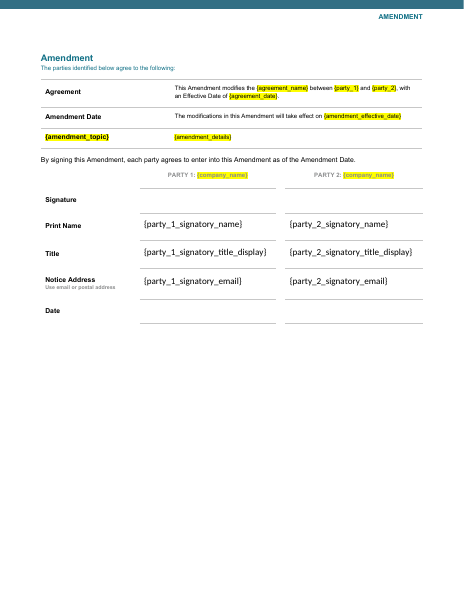 Common PaperAmendmentAn amendment template for modifying existing agreements, based on Common Paper's standard form. References the original agreement and details the specific changes being made.
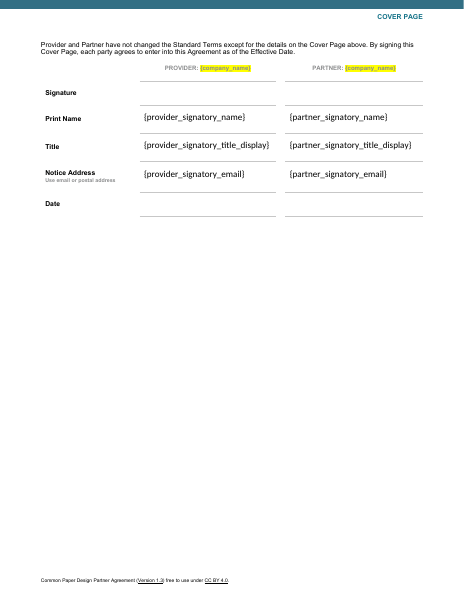 Common PaperDesign Partner AgreementCommon Paper's standard form can serve as a SaaS design partner agreement template for early product access, feedback, optional fees, confidentiality and feedback ownership. Unlike a non-binding letter of intent (LOI), its signed Cover Page incorporates the Standard Terms into a binding agreement.
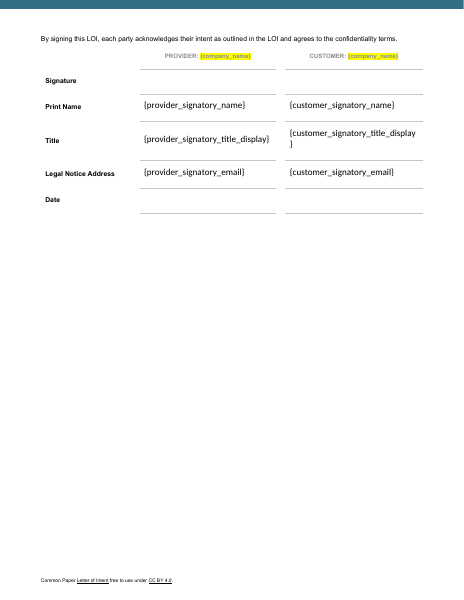 Common PaperLetter of IntentA letter of intent template for SaaS and technology deals, based on Common Paper's standard form. Outlines product, timeline, fees, and references an existing NDA.
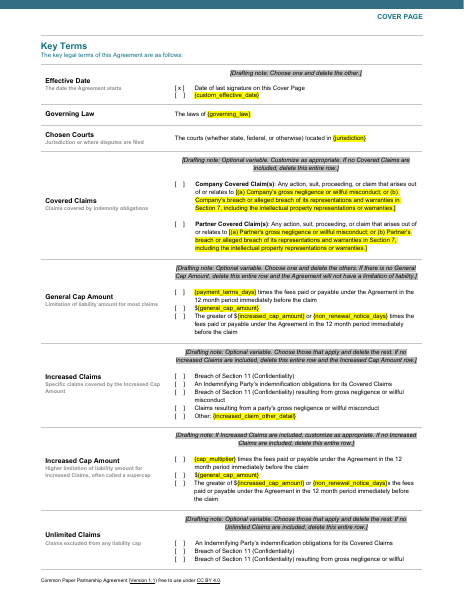 Common PaperPartnership AgreementA partnership agreement cover page and standard terms, based on Common Paper's standard form. Covers business partnerships including obligations, fees, territory, liability, and data processing.
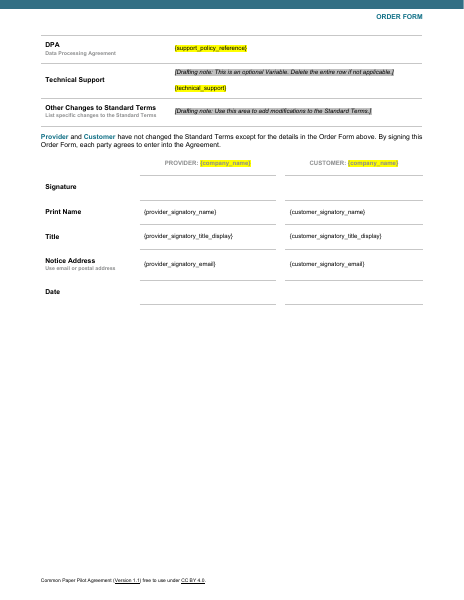 Common PaperPilot AgreementA pilot agreement cover page and standard terms, based on Common Paper's standard form. Covers trial or pilot periods for cloud services, including fees, support, and liability provisions.
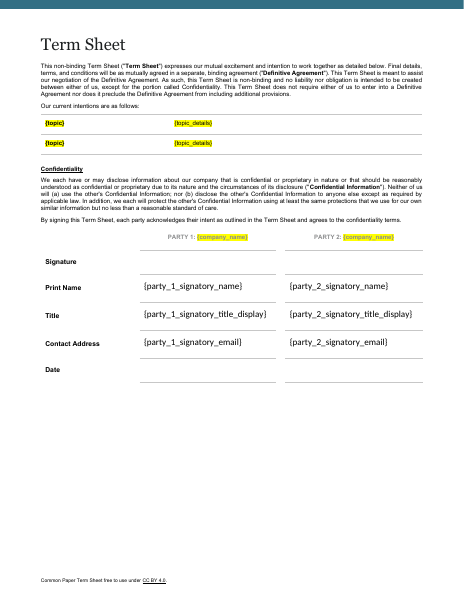 Common PaperTerm SheetA term sheet template for outlining key business terms, based on Common Paper's standard form. A simple topic-and-details format for early-stage deal discussions.
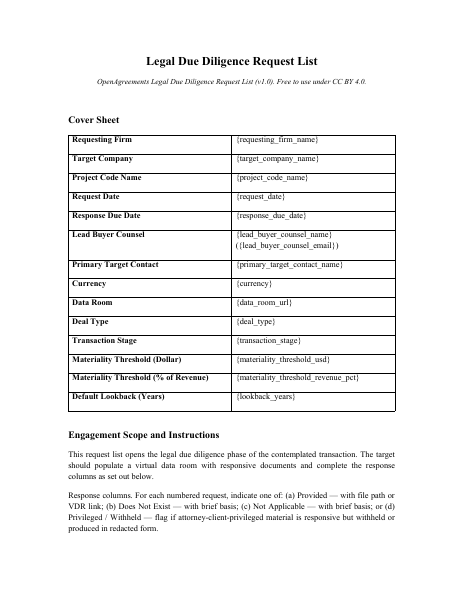 OpenAgreementsLegal Due Diligence Request ListModular legal due diligence request list (DDRL) for corporate transactions. Ships a base form covering organization, capitalization, contracts, IP, employment, litigation, compliance, tax, insurance, debt, property, and privacy/cybersecurity. Four optional industry riders gate via boolean toggles: tech / SaaS, life sciences, healthcare provider, and cross-border / trade compliance. Drafted clean-room from public-source consensus across 15 Am Law firm, bar association, and legal publisher DDRLs; no public source language is reused.
Sales & Licensing
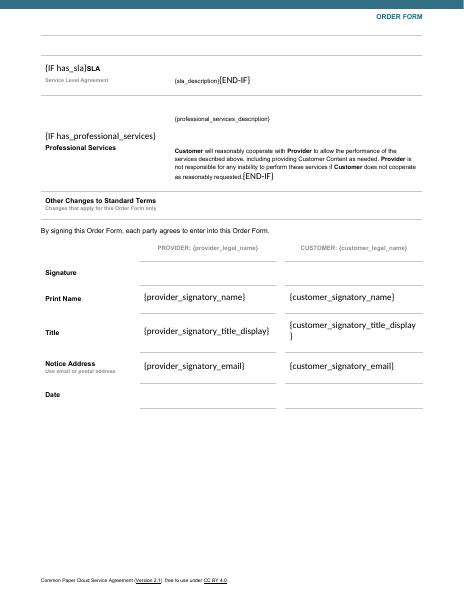 Common PaperCloud Service AgreementA cloud service agreement with order form and framework terms, based on Common Paper's standard terms. Covers SaaS subscriptions, payment, SLAs, liability, and data processing. Includes full Standard Terms v2.1.
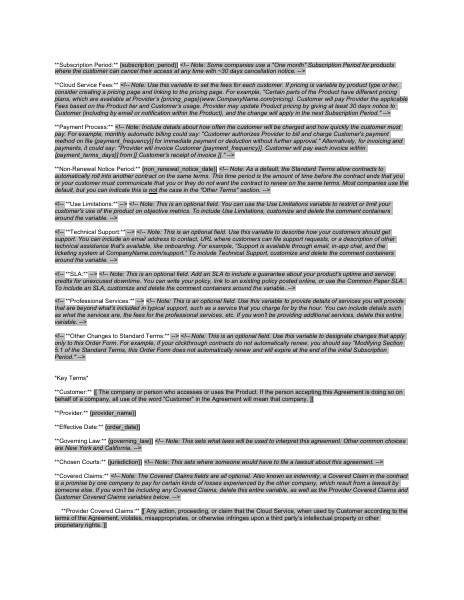 Common PaperCSA Click-ThroughA click-through cloud service agreement based on Common Paper's standard terms. Designed for self-serve SaaS products where the customer accepts terms online rather than negotiating a paper agreement.
 Common PaperCSA With AIA cloud service agreement with AI provisions, key terms, and standard terms, based on Common Paper's standard form. Extends the standard CSA with AI-specific terms covering model training, input/output rights, and AI usage policies.
 Common PaperCSA With SLAA cloud service agreement with SLA provisions, key terms, and standard terms, based on Common Paper's standard form. Includes uptime targets, response times, and support schedules alongside full CSA terms.
 Common PaperCSA Without SLAA cloud service agreement with key terms and standard terms, based on Common Paper's standard form. Covers SaaS subscriptions, payment, liability, and data processing.
 Common PaperOrder FormAn order form template for cloud service agreements, based on Common Paper's standard form. References existing Key Terms and covers subscription details, fees, pilot period, payment, and professional services.
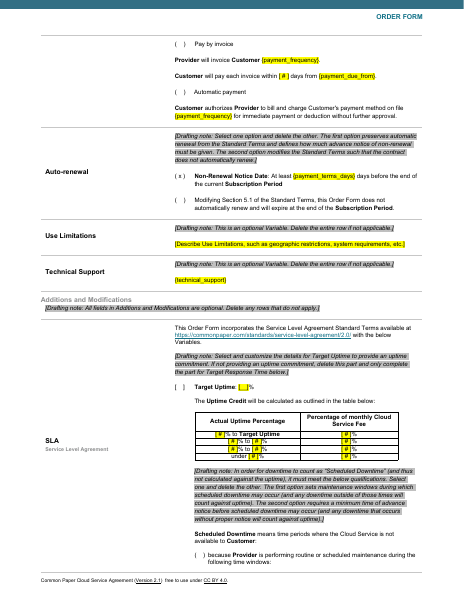 Common PaperOrder Form with SLAAn order form template with service level agreement (SLA) provisions, based on Common Paper's standard form. Extends the standard order form with uptime targets, response times, and support schedules.
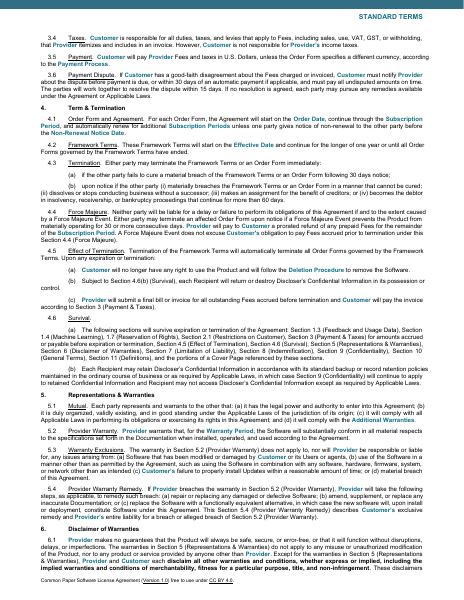 Common PaperSoftware License AgreementStandard terms for a software license agreement, based on Common Paper's standard form. Provides the framework terms for on-premise software licensing, to be used with a separate cover page and order form.
Professional Services
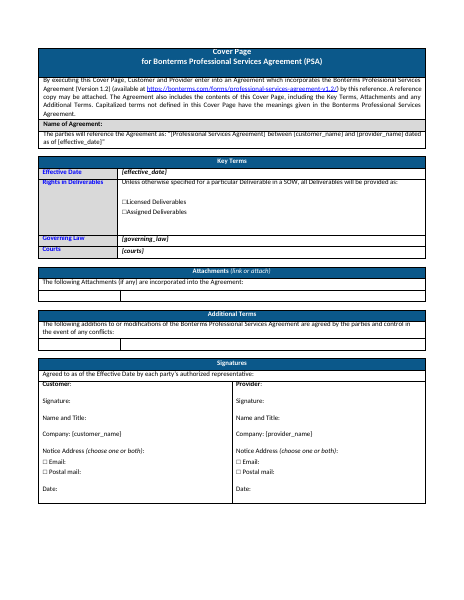 BontermsProfessional Services AgreementCover page for the Bonterms Professional Services Agreement (Version 1.2). The standard terms are incorporated by reference from bonterms.com.
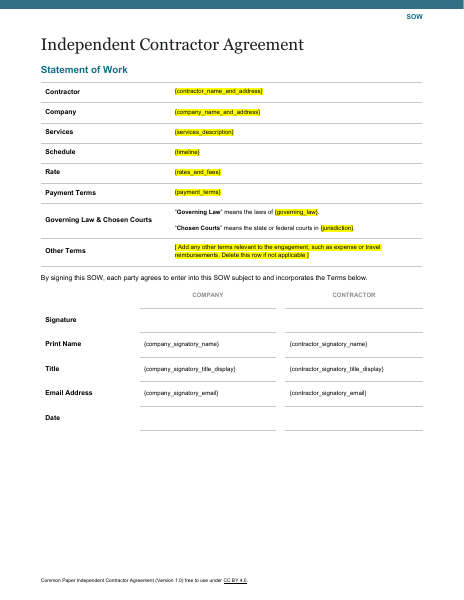 Common PaperIndependent Contractor AgreementAn independent contractor agreement based on Common Paper's standard form. Covers the engagement of an independent contractor, including scope of services, rates, payment, timeline, and governing law.
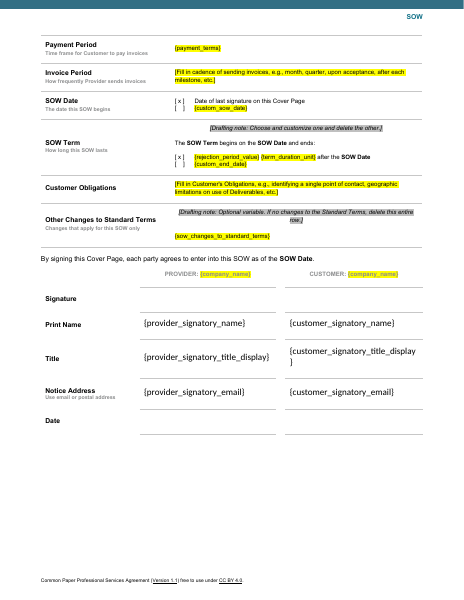 Common PaperProfessional Services AgreementCommon Paper's Professional Services Agreement covers consulting and can serve as a software implementation agreement. Its SOW sets services, deliverables, fees and customer obligations; terms address deliverable IP, liability limits, selected acceptance and written change orders.
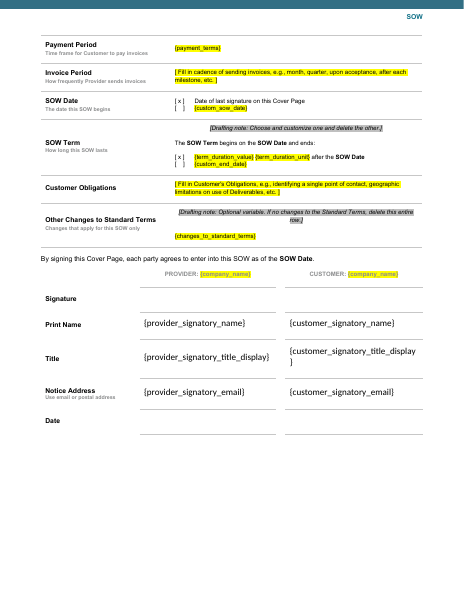 Common PaperStatement of WorkA statement of work template for professional services engagements, based on Common Paper's standard form. References a PSA or CSA Key Terms and covers scope, deliverables, timeline, fees, and expenses.
Venture Financing
- NVCAModel Certificate of IncorporationAmended and restated certificate of incorporation for venture-backed Delaware corporations, defining preferred stock rights, preferences, and privileges.
- NVCAModel Indemnification AgreementDirector and officer indemnification agreement for venture-backed companies, providing indemnification and advancement of expenses.
- NVCAModel Investors' Rights AgreementInvestors' rights agreement for venture financings, covering registration rights, information rights, board observer rights, and protective provisions.
- NVCAModel Management Rights LetterManagement rights letter granting ERISA-qualifying management rights to venture capital fund investors.
- NVCAModel Right of First Refusal and Co-Sale AgreementRight of first refusal and co-sale agreement for venture financings, restricting transfer of founder shares and providing investor co-sale rights.
- NVCAModel Stock Purchase AgreementSeries preferred stock purchase agreement for venture capital financings, covering purchase terms, representations, and closing conditions.
- NVCAModel Voting AgreementStandard-form voting agreement for venture capital financings, covering board composition, drag-along rights, and stockholder voting obligations.
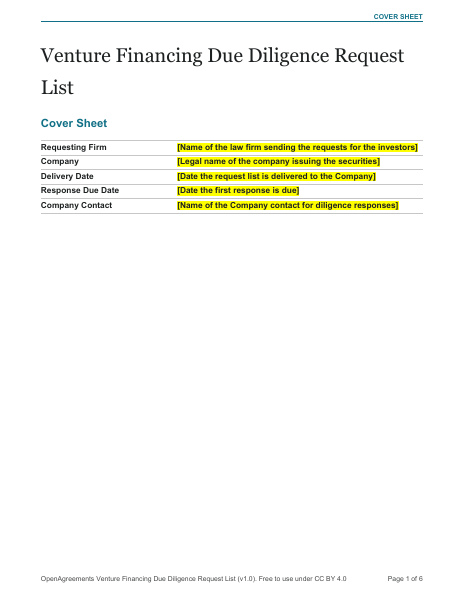 OpenAgreementsVenture Financing Due Diligence Request ListA starting request list for a priced preferred stock financing, structured on the common venture diligence categories.
Data, Privacy & Compliance
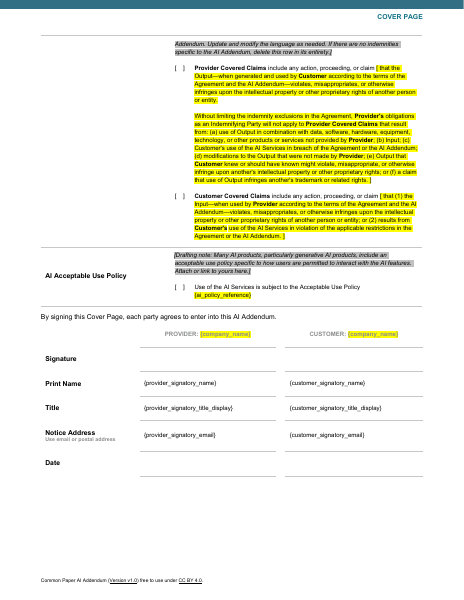 Common PaperAI AddendumAn AI addendum cover page and standard terms, based on Common Paper's standard form. Adds AI-specific provisions to an existing agreement, covering model training, input/output rights, and AI usage policies.
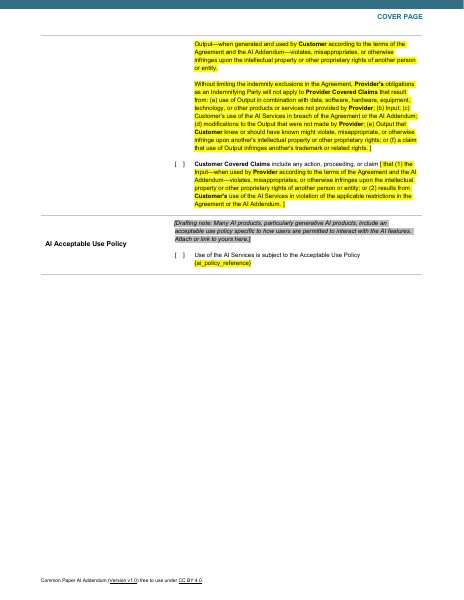 Common PaperAI Addendum In-AppAn in-app AI addendum based on Common Paper's standard form. A streamlined version of the AI addendum designed to be accepted electronically within an application.
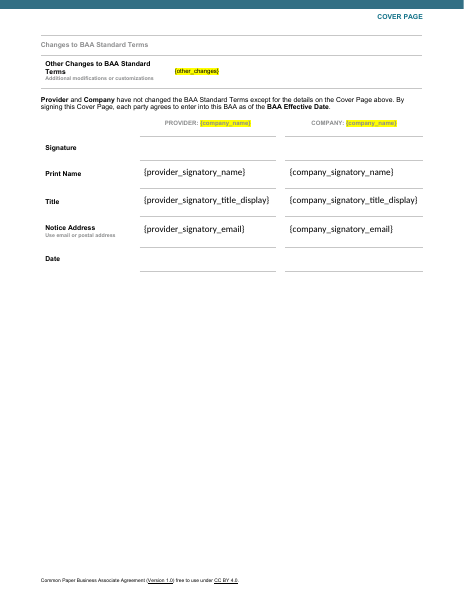 Common PaperBusiness Associate AgreementA HIPAA business associate agreement cover page and standard terms, based on Common Paper's standard form. Covers the use and protection of protected health information (PHI) between a covered entity and a business associate.
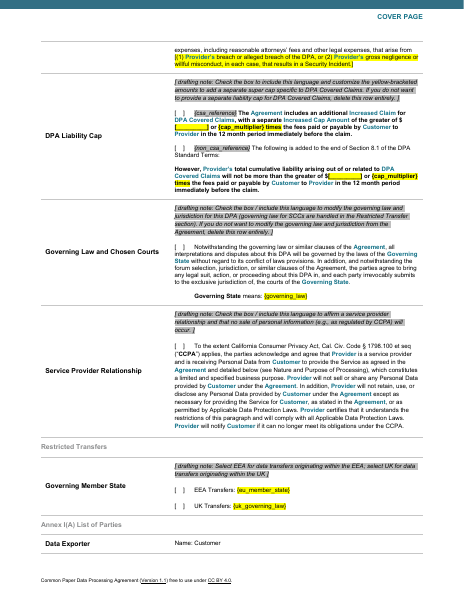 Common PaperData Processing AgreementA data processing agreement cover page and standard terms, based on Common Paper's standard form. Covers GDPR and data protection compliance, including processor/controller roles, data transfers, subprocessors, and security measures.
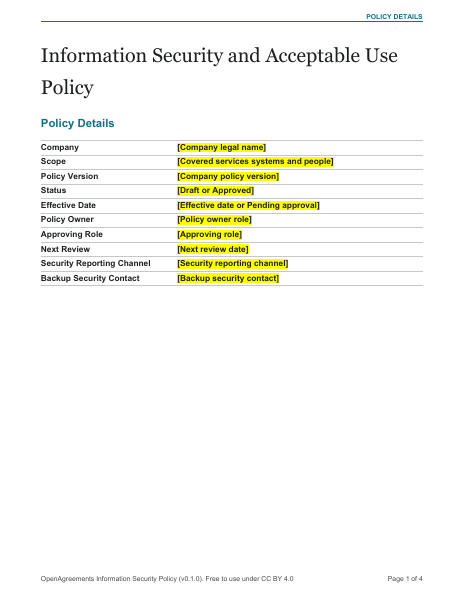 OpenAgreementsInformation Security and Acceptable Use PolicyEditable security rules for a small company's staff: account access, devices, data handling, remote work, reporting and onboarding. An initial policy, not a complete ISO 27001 or SOC 2 documentation set or an assurance of compliance.
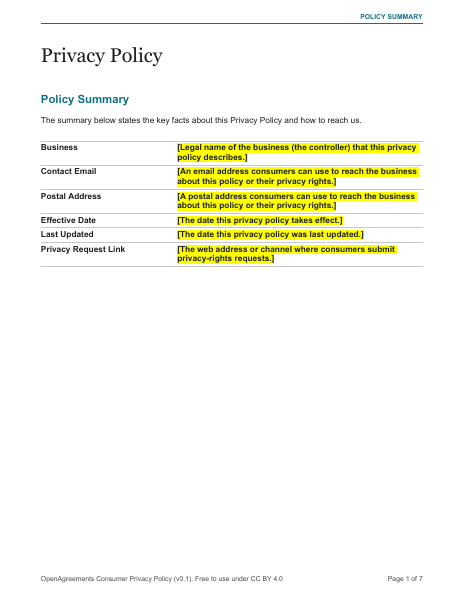 OpenAgreementsConsumer Privacy PolicyConfigurable national consumer privacy-policy template that assembles the union of U.S. state privacy-disclosure duties, gated by a business's coverage and data-practice facts.
SAFEs
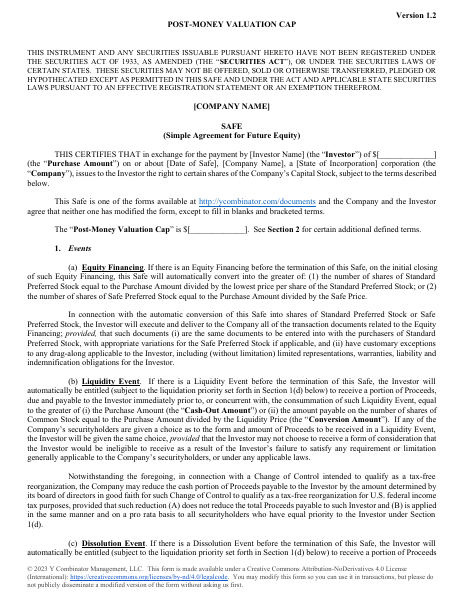 Y CombinatorYC Post-Money SAFE — Valuation CapMost commonY Combinator's Post-Money SAFE (Simple Agreement for Future Equity) with a valuation cap and no discount. The most common early-stage investment instrument.
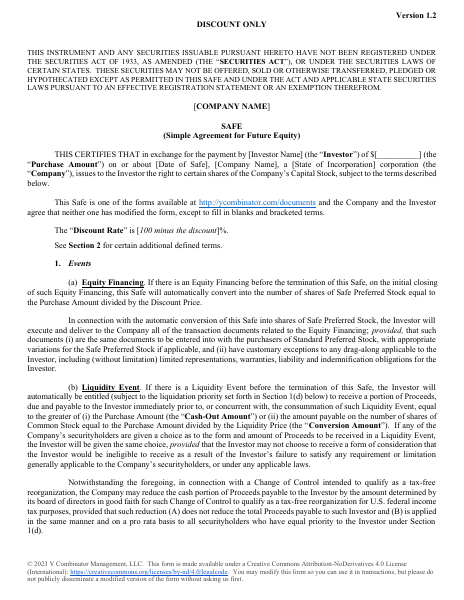 Y CombinatorYC Post-Money SAFE — DiscountY Combinator's Post-Money SAFE (Simple Agreement for Future Equity) with a discount rate and no valuation cap.
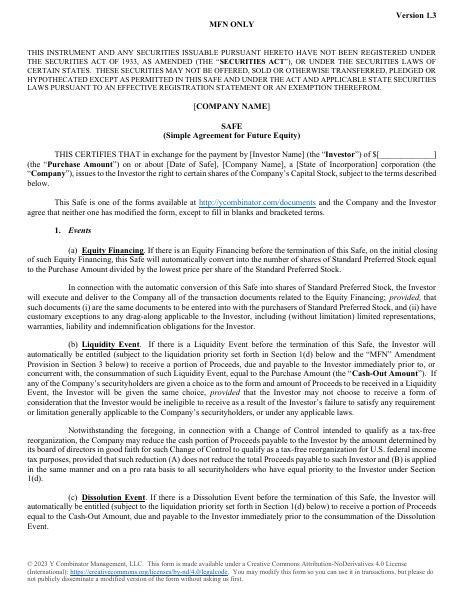 Y CombinatorYC Post-Money SAFE — MFNY Combinator's Post-Money SAFE (Simple Agreement for Future Equity) with a most favored nation (MFN) provision, no valuation cap, and no discount.
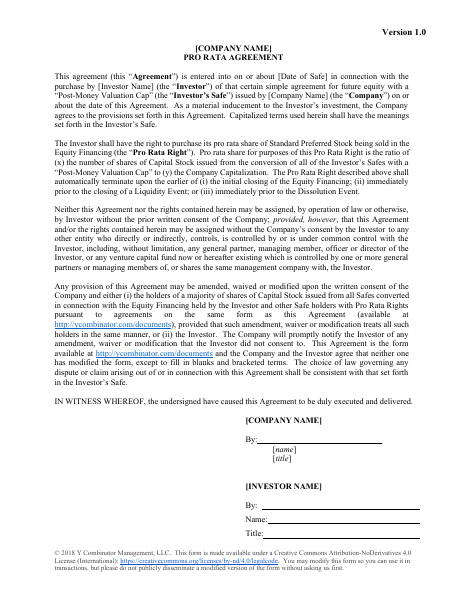 Y CombinatorYC Pro Rata Side LetterY Combinator's Pro Rata Side Letter, granting the investor pro rata rights in connection with a Post-Money SAFE investment.
Corporate Governance
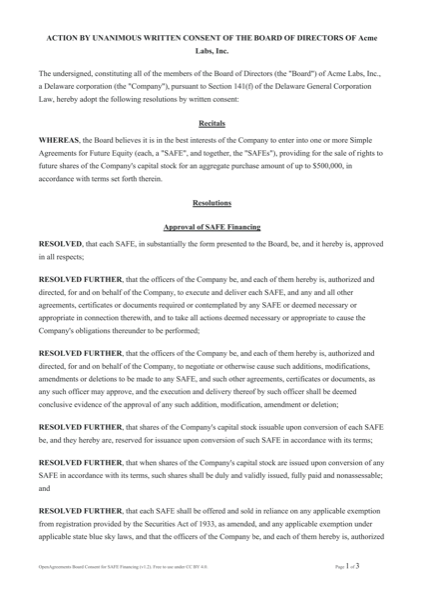 OpenAgreementsBoard Consent for SAFE FinancingAction by unanimous written consent of the board of directors of a Delaware corporation approving the issuance of one or more Simple Agreements for Future Equity (SAFEs).
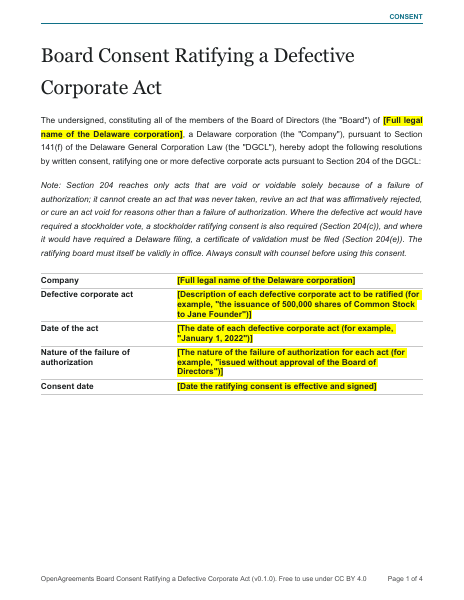 OpenAgreementsBoard Consent Ratifying a Defective Corporate ActAction by unanimous written consent of the board of directors of a Delaware corporation ratifying one or more defective corporate acts under Section 204 of the Delaware General Corporation Law — reciting each act, its date, any putative stock, and the nature of the failure of authorization, and directing the stockholder submission, certificate of validation, and notice the statute requires.
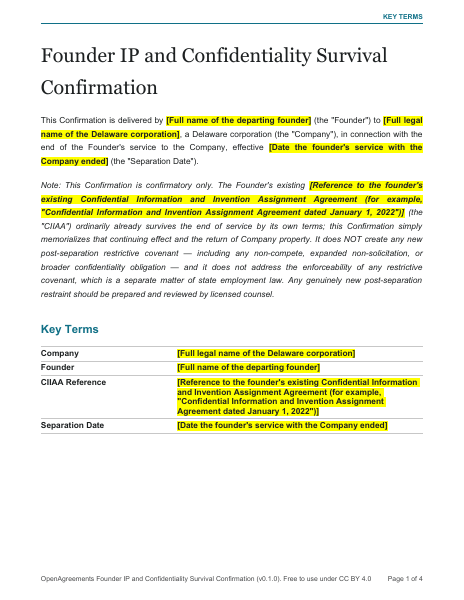 OpenAgreementsFounder IP and Confidentiality Survival ConfirmationA short confirmatory certificate signed by a departing founder and countersigned by the Delaware corporation confirming that the founder's existing Confidential Information and Invention Assignment Agreement (CIIAA/PIIA) and confidentiality obligations remain in full force after service ends, that all company property and repositories have been returned, and that no release is intended as to those continuing obligations. It is confirmatory only and creates no new restrictive covenant. Drafted as a starting point for licensed counsel review.
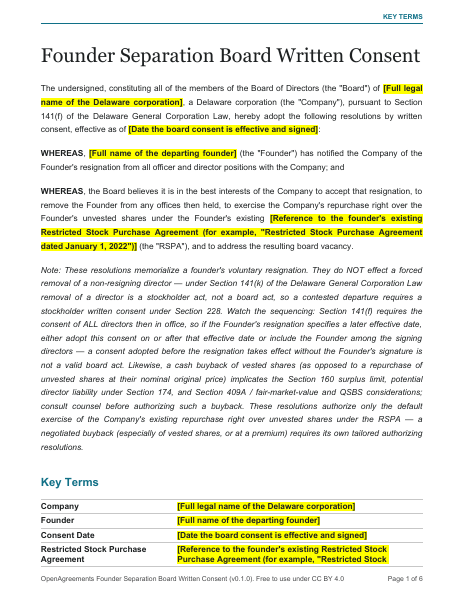 OpenAgreementsFounder Separation Board Written ConsentAction by unanimous written consent of the board of directors of a Delaware corporation memorializing a founder's departure: accepting the resignation, removing the founder from officer titles, authorizing the repurchase of unvested shares under the founder's existing Restricted Stock Purchase Agreement, and managing the vacated board seat. Drafted as a starting point for licensed counsel review.
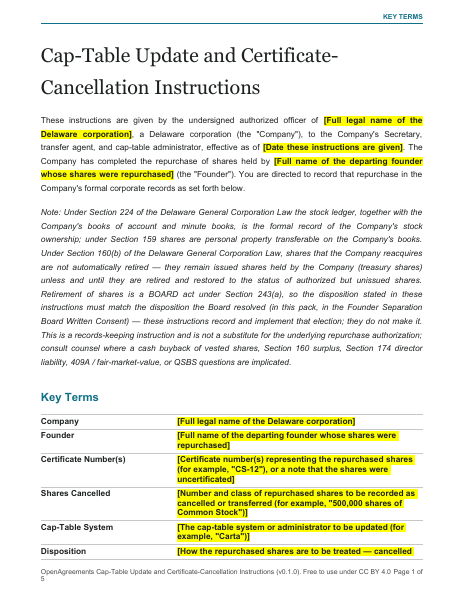 OpenAgreementsCap-Table Update and Certificate-Cancellation InstructionsWritten instructions from an authorized officer of a Delaware corporation to the corporate secretary, transfer agent, or cap-table administrator to record a completed founder share repurchase: cancel or take possession of the repurchased certificates (or make the book-entry transfer for uncertificated shares), update the stock ledger, and reflect the disposition — cancelled and retired or held as treasury — on the cap table. Drafted as a starting point for licensed counsel review.
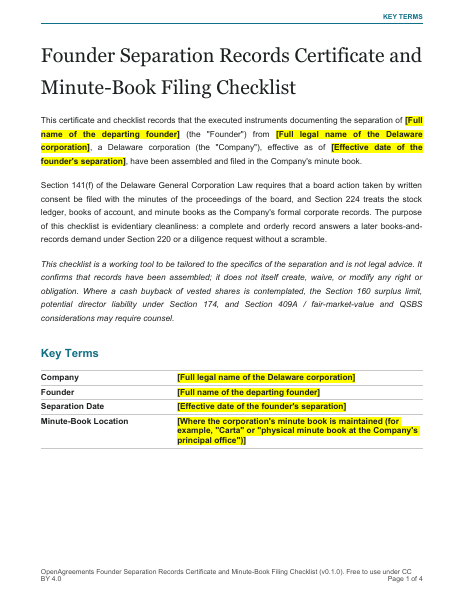 OpenAgreementsFounder Separation Records Certificate and Minute-Book Filing ChecklistA closing certificate and filing checklist for assembling a founder departure's executed instruments into a Delaware corporation's minute book: the board written consent, resignation letter, repurchase notice and repurchase agreement, proof of payment, any stockholder-consent notices, the IP/confidentiality confirmation, and the stock-ledger and cap-table updates. Drafted as a starting point for licensed counsel review.
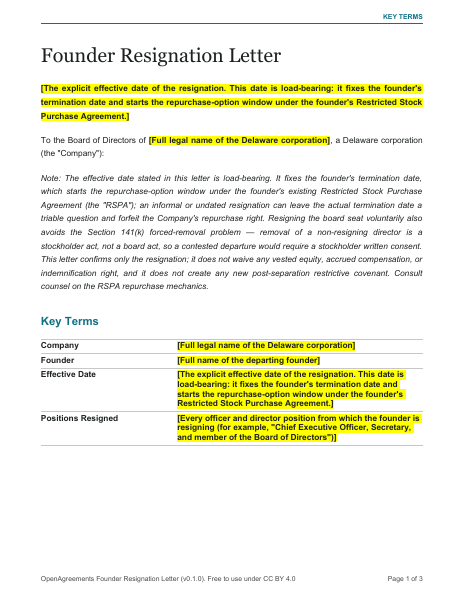 OpenAgreementsFounder Resignation LetterA short letter from a departing founder to the board of directors of a Delaware corporation resigning from every officer and director position held, with an explicit effective date. The effective date is load-bearing: it fixes the termination date that starts the repurchase-option window under the founder's existing Restricted Stock Purchase Agreement. Drafted as a starting point for licensed counsel review.
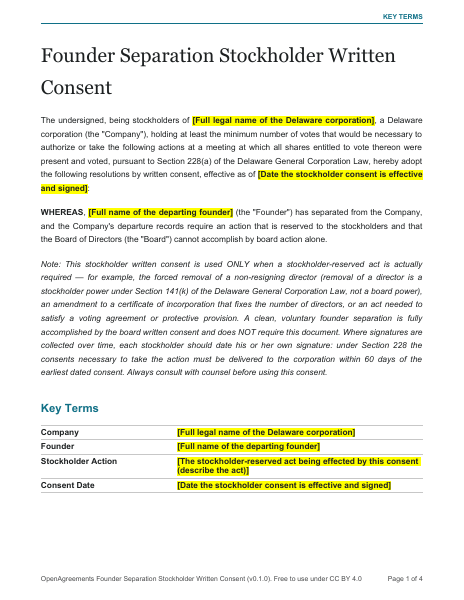 OpenAgreementsFounder Separation Stockholder Written ConsentAction by written consent of the stockholders of a Delaware corporation under Section 228 of the DGCL effecting a stockholder-reserved act in connection with a founder's departure — such as the forced removal of a non-resigning director under Section 141(k), an amendment to a charter that fixes board size, or the satisfaction of a voting agreement or protective provision. Used only when a stockholder act is required; a clean voluntary separation stops at the board consent. Drafted as a starting point for licensed counsel review.
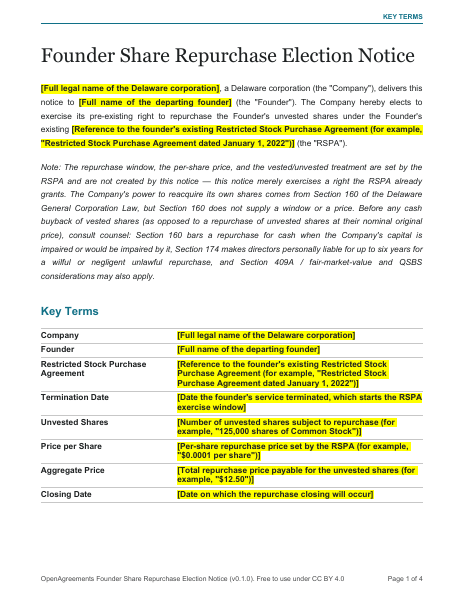 OpenAgreementsFounder Share Repurchase Election NoticeWritten notice from a Delaware corporation to a departing founder electing to exercise the company's pre-existing right to repurchase the founder's unvested shares within the exercise window set by the founder's Restricted Stock Purchase Agreement, identifying the governing agreement, termination date, unvested share count, per-share and aggregate price, and closing date. Drafted as a starting point for licensed counsel review.
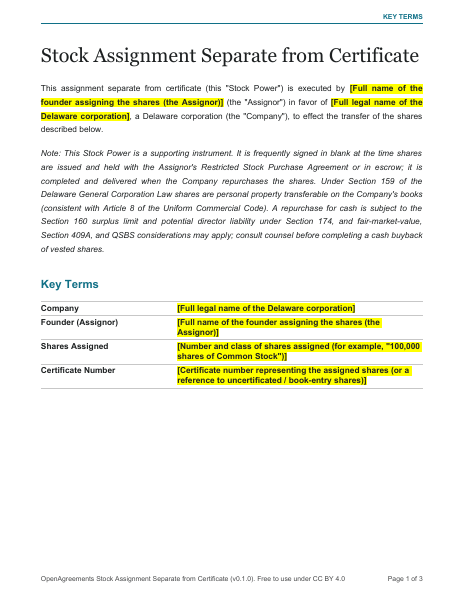 OpenAgreementsStock Assignment Separate from CertificateA stock power (assignment separate from the certificate) by which a founder, for value received, assigns repurchased shares of a Delaware corporation back to the corporation and appoints an attorney-in-fact to transfer the shares on the corporation's books. Often pre-signed at issuance and held with the Restricted Stock Purchase Agreement or in escrow; here it effects the transfer of the repurchased shares. Drafted as a starting point for licensed counsel review.
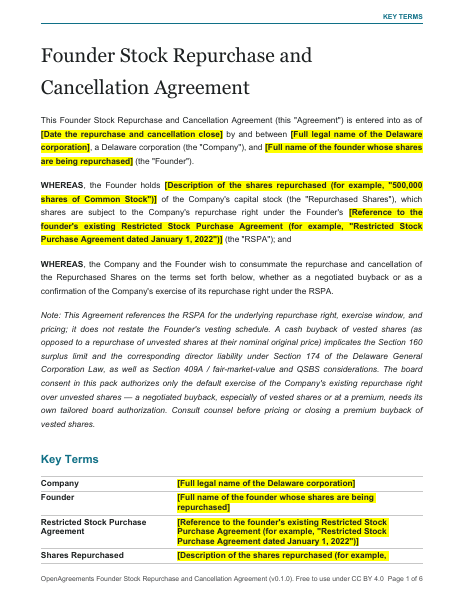 OpenAgreementsFounder Stock Repurchase and Cancellation AgreementAgreement between a Delaware corporation and a departing founder consummating the repurchase and cancellation of the founder's shares, whether as a negotiated buyback or as a belt-and-suspenders confirmation of a repurchase right exercised under the founder's existing Restricted Stock Purchase Agreement, with an optional mutual-release rider. Drafted as a starting point for licensed counsel review.
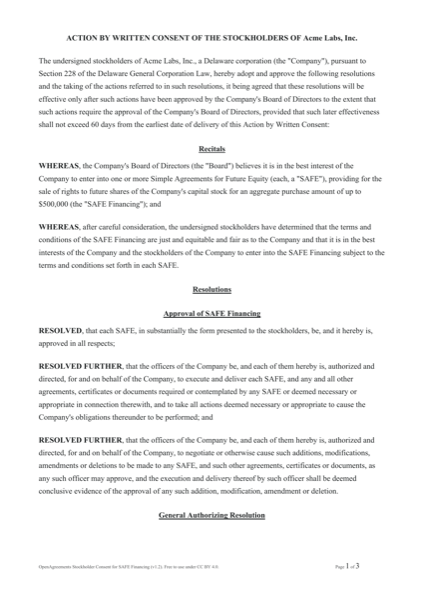 OpenAgreementsStockholder Consent for SAFE FinancingAction by written consent of the stockholders of a Delaware corporation approving the issuance of one or more Simple Agreements for Future Equity (SAFEs).
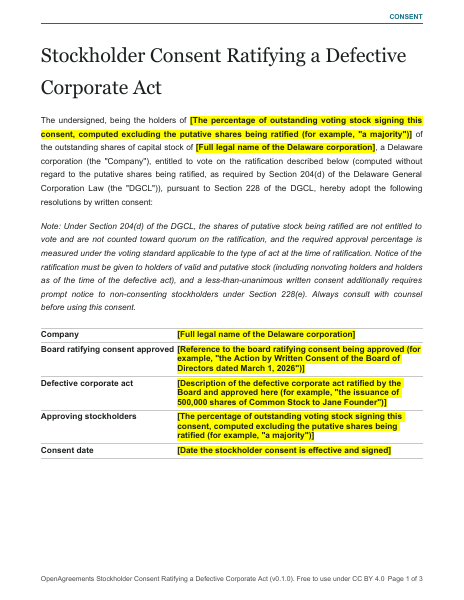 OpenAgreementsStockholder Consent Ratifying a Defective Corporate ActAction by written consent of the stockholders of a Delaware corporation approving the board's ratification of a defective corporate act under Section 204 of the Delaware General Corporation Law — approving the specifically identified act, and approving any related charter amendment or certificate of validation the cure requires.
Private funds
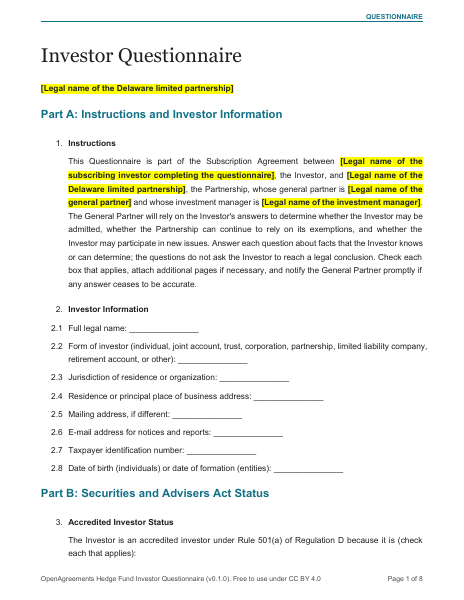 OpenAgreementsHedge Fund Investor QuestionnaireInvestor questionnaire for a hedge fund, meaning an open-end private investment fund organized as a Delaware limited partnership, that collects the facts the general partner needs to decide whether a subscriber may be admitted: accredited-investor and qualified-client status, the Investment Company Act beneficial-owner count, benefit plan status, tax and anti-money-laundering information, bad-actor facts, and FINRA new-issue eligibility. It is completed with the Hedge Fund Subscription Agreement.
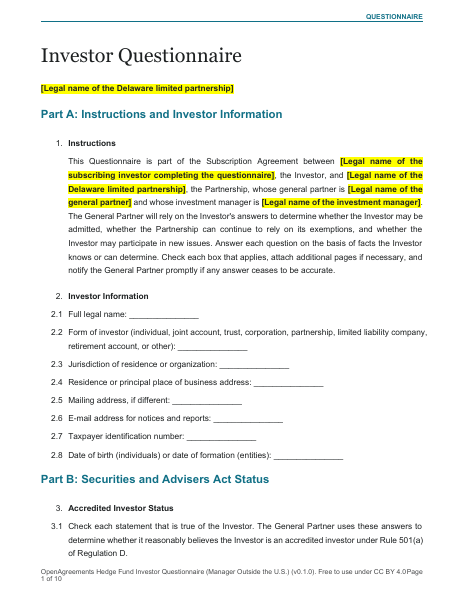 OpenAgreementsHedge Fund Investor Questionnaire (Manager Outside the U.S.)Investor questionnaire for a hedge fund organized as a Delaware limited partnership whose investment manager has its principal office and place of business outside the United States. It is the Hedge Fund Investor Questionnaire with the questions that change for a non-U.S. manager, including each investor's United States status, which the manager uses to count its clients and investors in the United States.
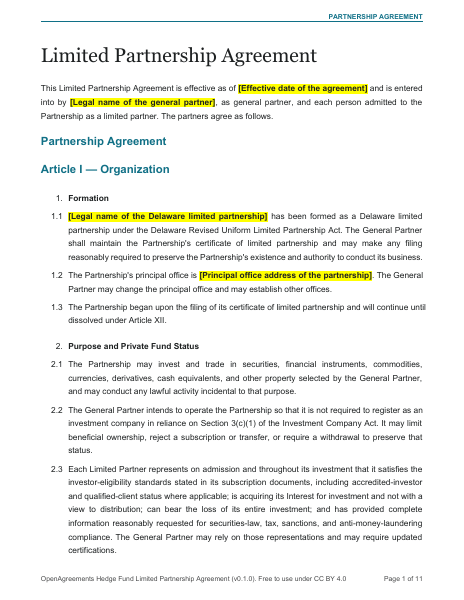 OpenAgreementsHedge Fund Limited Partnership AgreementLimited partnership agreement for a hedge fund, meaning an open-end private investment fund organized as a Delaware limited partnership and relying on Section 3(c)(1) of the Investment Company Act. Investors subscribe and withdraw on stated dates rather than committing capital to be drawn down, so it suits a fully funded trading fund and not a closed-end fund.
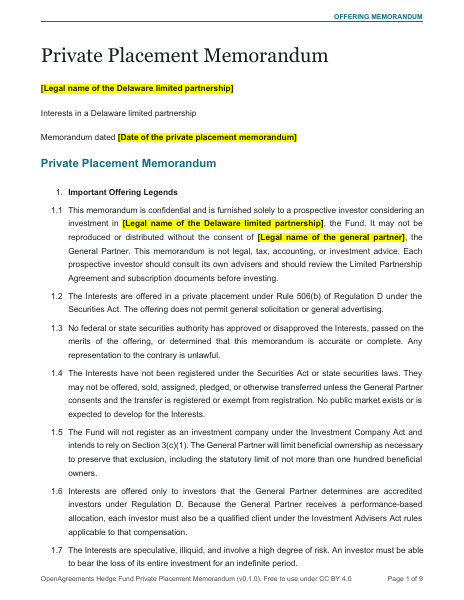 OpenAgreementsHedge Fund Private Placement MemorandumPrivate placement memorandum skeleton for a hedge fund, meaning an open-end private investment fund organized as a Delaware limited partnership and relying on Section 3(c)(1) of the Investment Company Act, offering its interests under Rule 506 of Regulation D.
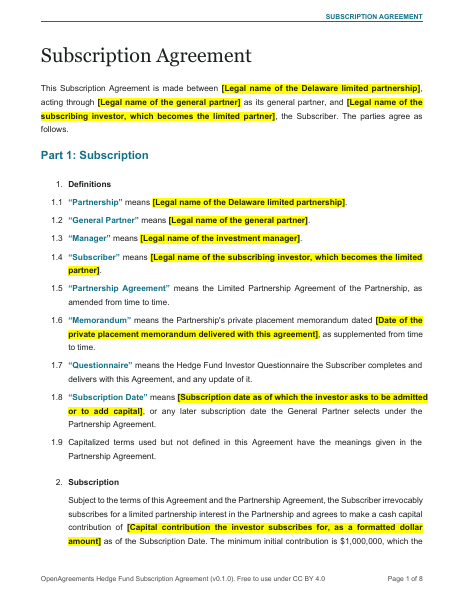 OpenAgreementsHedge Fund Subscription AgreementSubscription agreement for a hedge fund, meaning an open-end private investment fund organized as a Delaware limited partnership, through which an investor applies to buy a limited partnership interest on a subscription date and becomes bound by the fund's limited partnership agreement. It is drafted for the manager's side and works with the Hedge Fund Investor Questionnaire, which collects the facts the investor representations rely on.
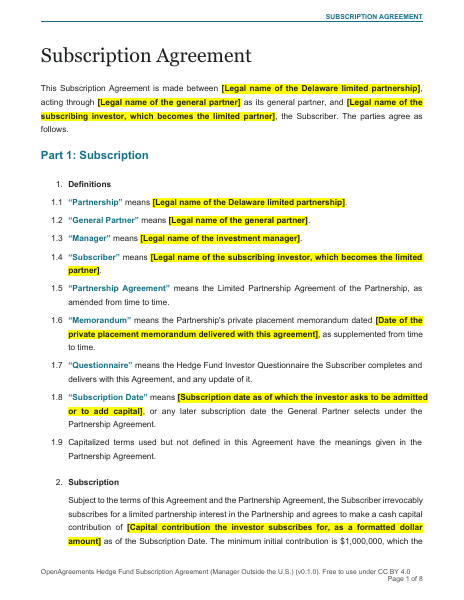 OpenAgreementsHedge Fund Subscription Agreement (Manager Outside the U.S.)Subscription agreement for a hedge fund organized as a Delaware limited partnership whose investment manager has its principal office and place of business outside the United States. It is the Hedge Fund Subscription Agreement with the terms that change for a non-U.S. manager: the qualified-client admission condition, the manager's home regulator, its home-country privacy notice, and anti-money-laundering and sanctions law.
Other
 OpenAgreementsClosing ChecklistA stage-first, document-first closing checklist that tracks canonical documents, action items, and open issues for a transaction, and renders a formatted document for distribution to the working group. Optional static priced-equity-financing starter text appears alongside the matter-specific rows.
 OpenAgreementsWorking Group ListStandalone working group roster for a transaction. Tracks staffed deal team members and their contact details outside the closing checklist document.